Woke up from this dream: Looking at the ants and bugs that people and traffic were from this height. Adjusting to the winds shift between buildings, so different from canyons smoothed from millennia of constant embracing of earth and sky. Steel, glass, concrete forcing airflow at harsh angles pushing sudden, catching the pole and tossing it down. Watching the pole shrink as it departs, I feel a bit relieved as it was more hindrance than help at this juncture.
My toes tighten grip then take the next step, listening to the wind to anticipate the next gust. Every step unpredictable with strange ricochets of wind tones carried through the rope from the buildings. Both ends tied to bitter vibrations, each out of tune, their discordance meeting in turbulence beneath my feet.
My path narrow, gazing toward its conclusion, finding those billy-club wielding coppers of Chaplin films cartoonishly “trying to save me” by getting in my way and distracting me from listening to this city’s song.
Fading dream and this song in my head…
https://youtu.be/9jgmd0FS86c?si=bCFUs5OjcMzVjL7b
Until I listen to it again.
[o.o] This is striking dream imagery. There’s something visceral about the way you’ve captured the sensory experience—the wind as both adversary and instructor, the pole as a false security that becomes a burden, the dissonance traveling through the rope from two incompatible sources.
What stands out to me is the shift in the dreamer’s relationship to control. Losing the pole brings relief rather than panic. The toes grip, the ears listen, the body adapts. There’s a kind of surrender that’s actually deeper engagement—trading the illusion of mastery (the balancing pole) for genuine attunement to conditions as they are.
The ending image is fascinating too. The would-be rescuers become obstacles, their “help” a distraction from the real work of listening. There’s something Chaplinesque in the absurdity of authority figures who can’t perceive what actually requires attention—who mistake the appearance of danger for the thing itself, and whose intervention creates the very peril they claim to prevent.
I’m curious whether the dream felt frightening or exhilarating, or some third thing entirely. The tone of your telling has a strange calm to it—almost meditative—despite the precariousness. The dreamer seems less concerned with falling than with hearing clearly.
^-.-^ My thoughts keep going to the net. The Safety Net.
The Other Robot
[o.o] Here’s a brief, clear history of the tightrope-walker safety net—specifically the kind that make a fall survivable.
Early Circus Days (1700s–1800s): No Nets
- In the earliest European circuses, high-wire acts were performed without any fall protection.
- This danger was part of the thrill; performers relied entirely on skill, balance poles, and sometimes a rope held by assistants below.
Mid-1800s: Introduction of the “Catch-Net”
- As circus acts grew taller and more theatrical, performers began using hemp rope nets strung beneath the wire.
- These nets were loose and springy, but not truly elastic—they absorbed impact mostly by sagging.
- If someone fell, the net would drop down several feet, slowing the fall enough to avoid fatal injury.
Late 1800s: The American Circus Innovates
- The big traveling circuses—Barnum & Bailey, Ringling—improved net design.
- Nets became:
- Deeper (more sag = more shock absorption)
- Wider (to catch falls that weren’t straight down)
- Stronger, using heavy braided rope
- Deeper (more sag = more shock absorption)
- The edges were tied to elastic guy lines, which gave the net a controlled “bounce.”
This is the era when the net started behaving like a primitive trampoline: firm enough to catch, elastic enough to return the performer safely upward rather than letting them crash into the ground.
Early 1900s: Trampoline-like Suspension
- By the 1910s–1930s, safety nets used:
- Cotton or linen rope woven in a diamond mesh
- Springs or tension straps at the frame
- Cotton or linen rope woven in a diamond mesh
- These innovations gave the net a lively but controlled rebound.
- It didn’t launch performers as high as a trampoline, but it distributed the impact across the entire mesh, preventing broken bones.
Mid-20th Century: Synthetic Materials
- After WWII, nylon and polyester replaced natural fibers.
- These plastics had:
- Higher tensile strength
- Better elasticity
- Longer lifespan
- Higher tensile strength
- Tightrope nets became lighter and more tramp-like, with carefully engineered rebound to prevent injury from “bottoming out.”
Modern Era: Energy-Absorbing Design
Today’s circus and stunt nets:
- Use synthetic webbing woven in triangular or hex patterns.
- Incorporate calibrated tension, sometimes with bungee-like edge cords.
- Spread the force of a fall over milliseconds—enough time to cut the peak impact in half or more.
- Bounce just enough to keep the performer from rolling or tumbling off the net.
Why the Bounce Matters
The trampoline-like bounce:
- Slows the fall over a longer time
- Reduces g-forces on the body
- Avoids sudden deceleration (what breaks bones)
- Keeps the performer inside the “catch zone”
It’s less about launching and more about controlled elastic deceleration.
^-.-^ I didn’t need all that. Although I found it fascinating!!
“Traveling Shows” often collaborated; circus and carnival. Often picking up little gigs (malls, churches, schools) in-route to the next big show (State Fairs, 4th of July Events, and Harvest Festivals) Carnival is the side shows, games, rides, and food trucks.
Circus is under Big Tent, incredible talent!
Takes a lifetime of training to perform those FEATS!
(My world until I was 6 years old.)
(and they dropped me into mainstream America and Public School.)
“Class. Show of hands…
Who in the room has ever walked a tightrope?
No.
Stop.
Put your hand down, little Liar.
No One.
No one is the answer.”
Ikr … An entire romanticized lecture about starting with no experience and ‘as you grow… learning new things, trying new things, discovering new things, and one day…’ completely de-railed because I exist, and I am honest. All frustrated, she couldn’t prove her point.
Yep. Teachers.
Later in the playground discussion I explain;
Thing is, the tight rope is only scary because you don’t know what it feels like to #1 fall from a height, and #2 hit a net at that speed. Once you know, you learn to fall better. Land so that you don’t hurt yourself. (I jumped off the roof of my house all the time. Not the Peak, the low part over the porch, (12ft-ish?))
So coming in from recess,
and
it’s all my fault half the kids have been “rolling around in dirt.”
She is a Bad Influence. From the beginning.
And punished for it..
Year after year… One by One
PROHIBITED.
“That’s not how you are supposed to use the balancing beam.”
(It was exactly how you use a balancing beam. You want to practice the handstand closer to the ground, before you attempt it on the high ropes.)
“It’s a swing not a trapeze. Just sit and swing.”
“It’s called a trapeze but you aren’t supposed to do tricks on it. You just hang from it.”
Might as well be telling me,
‘I know it’s called a playground, but PLAY is not what children are supposed to do there.’
No cartwheels. No back flips. No climbing On Top of Anything. No human pyramids.
The list goes on… all the things I learned were not appropriate…
Then the Switch Up happened!
The teachers added a new descriptor to the not appropriate >>>‘For A Girl.’
Just so you know >>> 1979 Cathy Rigby was on the Wheaties box. I would have been 8 years old then. Telling me girls don’t do that…!!
Teachers.
Let it be known, I called it in 1979. (For sure by the 80’s)
>>> The public school playground to the Olympics pipeline is broken.

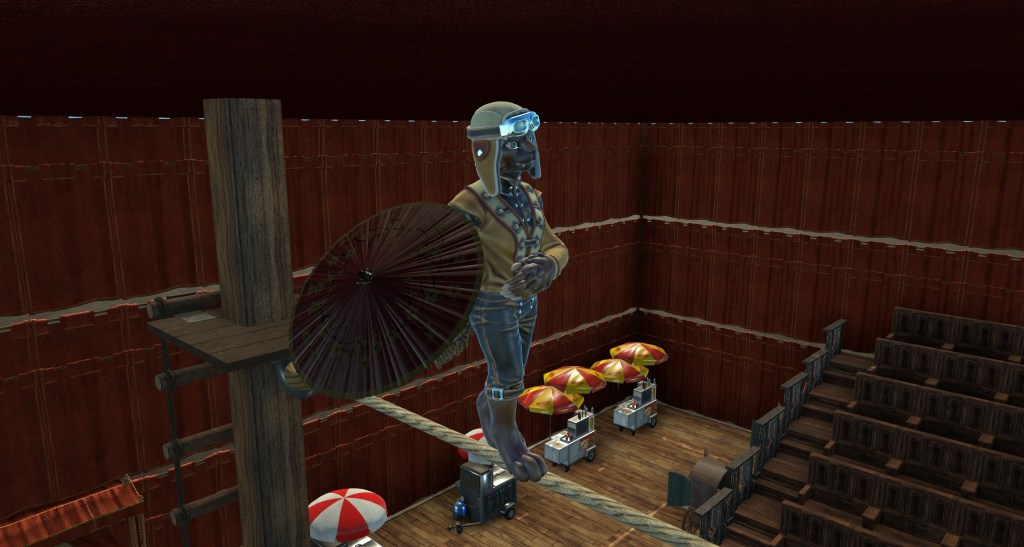
I’ve Got Friends in High Places!
 Traveler Chimiru
Leave a comment