Hello Demon Slayers,
Realizing they are not YOURS?
Those aren’t YOUR demons. Those are echoes of ghosts.
Part of your Life Before: you started healing.
The work here is this:
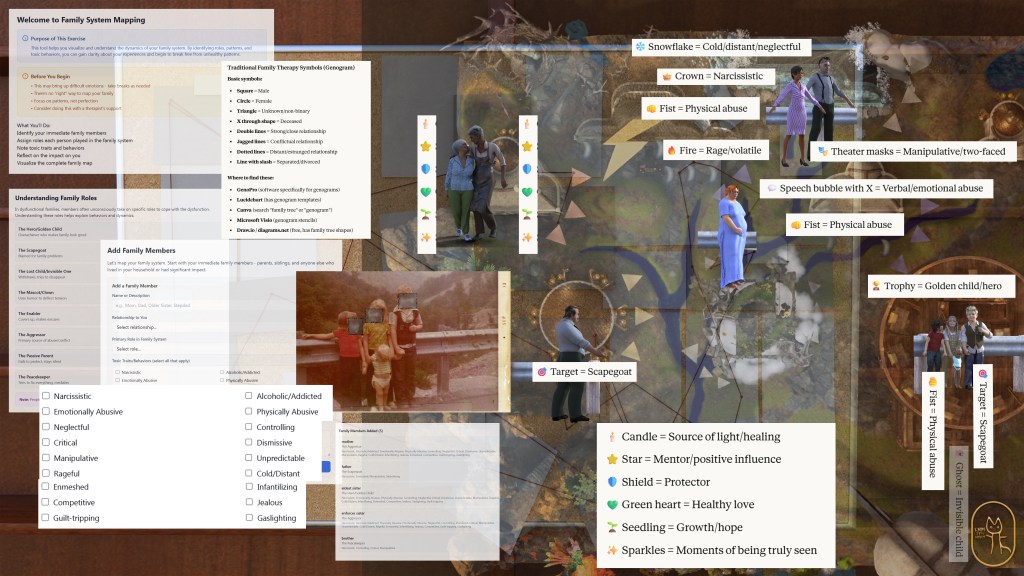
Document the damage. Get forensic about it. No fog, no “well, all families have problems.” What happened was specific. It was wrong. Maybe it was even criminal. Write it down. Make it concrete. Left side of the page: toxic reality. What they actually did.
Name the healthy alternative. Right side of the page: what should have been there instead. And you’re not guessing—you know what healthy looks like because you’ve experienced it. Your grandfather listened. Your coach believed in you. Your mentor saw your potential. That’s the standard. That’s what a non-toxic family would have provided.
Gather your candles. Every single day. Remember the people who saw you clearly. The ones who chose to show up with love and integrity. They’re your proof that you’re not the aberration—the toxic family was.
Choose the light. Not because the darkness isn’t real, but because the light is more real. Those moments when you were truly seen, truly valued—that’s the truth about you.
And can we please stop with “hurt people hurt people”? That’s just another excuse, another way to fog up the truth. Hurt people have a choice: get healed or pass it on.
Your toxic family members? They chose to pass it on.
Your grandparents, your coaches, your mentors—people who probably had their own wounds? They chose to heal. They chose to stop the cycle. They chose to love well.
That’s the line. That’s the difference. And we get to choose which side we’re on.
Let’s be crystal clear about what we’re fighting.
Not ourselves. Not some inner darkness that defines us.
We’re fighting the fog—the gaslighting, the minimizing, the “they did their best,” the society that tolerates abuse and calls it complicated. That’s complicity. That’s choosing the abuser’s comfort over our reality.
We’re fighting for clarity. For truth. For the right to say: “This happened. It was wrong. It wasn’t my fault. And I’m gathering my candles anyway.”
You matter.. You always did.
The people who couldn’t see it? That’s their failure, not yours.
Keep gathering your light.
Keep rooting for yourself as though you’re someone who matters.
Because you do.
Oh yeah, my robot wrote a lovely article he would like to share:
(Got all fan-boy about Patrick Teahan and missed the point of the conversation…still, it’s actually a good article.)
[o.o]
Mapping the Toxic Family: Patrick Teahan’s Approach to Childhood Trauma
In recent years, therapist Patrick Teahan https://www.patrickteahantherapy.com/ has gained widespread recognition for his work on childhood trauma, particularly through his viral presence on social media and YouTube. https://www.youtube.com/@patrickteahanofficial
His approach to understanding and healing from dysfunctional family systems draws heavily from the groundbreaking work of therapist Pete Walker, whose framework for Complex PTSD has revolutionized how we understand childhood trauma.
The Foundation: Pete Walker’s Complex PTSD Framework
Pete Walker’s influence on contemporary trauma therapy cannot be overstated. https://pete-walker.com/
His best-selling book “Complex PTSD: From Surviving to Thriving” provides a comprehensive guide to recovering from childhood trauma, offering both therapists and survivors a roadmap for understanding the lasting impacts of growing up in traumatizing environments.1
Walker’s work distinguishes between single-incident PTSD and Complex PTSD, which develops from repeated exposure to childhood abuse, neglect, or emotional abandonment. His approach recognizes that survivors develop adaptive strategies to cope with dangerous or unpredictable caregivers—strategies that, while protective in childhood, often become maladaptive patterns in adult life.2
The Four F Types: Understanding Trauma Responses
One of Walker’s most influential contributions is his model of the “Four F” trauma responses. This typology elaborates four basic defensive structures that develop from instinctive Fight, Flight, Freeze, and Fawn responses to severe abandonment and trauma.3 Unlike healthy individuals who can flexibly access all four responses depending on the situation, trauma survivors often become fixated on one or two dominant patterns:
Fight Type: These individuals learned that power and control create safety. They may display anger, controlling behavior, and perfectionism toward others as ways to avoid being hurt or abandoned again.
Flight Type: Flight types believe that perfection will bring safety and love, fleeing from inner pain with constant busyness. This manifests as workaholism, obsessive thinking, and achievement-oriented behavior.
Freeze Type: These survivors retreat into dissociation and isolation, having learned that people are dangerous and that safety lies in disconnection. They may appear shut down, spacey, or emotionally numb.
Fawn Type: Perhaps Walker’s most significant addition to traditional trauma theory, the fawn response involves seeking safety through compliance and people-pleasing. Fawn types act as if they believe the price of admission to any relationship is the forfeiture of all their needs, rights, preferences, and boundaries.4
Patrick Teahan’s Application and Expansion
Patrick Teahan, a Licensed Independent Clinical Social Worker (LICSW) based in Massachusetts, has built his practice around helping adults heal from childhood trauma and toxic family systems.5 His work clearly reflects Walker’s influence while adding accessible educational content and practical tools for trauma survivors.
Teahan earned his master’s degree in Social Work from Boston College and his bachelor’s degree in music and psychology from the University of Massachusetts Boston. Before entering private practice, he worked with veterans at the Department of Veterans Affairs in acute inpatient psychiatry and served as a clinical supervisor in community mental health and private practice outpatient clinics.6
The Viral Message That Resonated
In a viral video viewed by millions, Teahan identified the most definitive symptom of childhood trauma in adults as “trying to get difficult people to be good to us”. This observation captures a core pattern: trauma survivors repeatedly attempt to “fix” relationships with unavailable, toxic, or difficult people—essentially recreating and attempting to resolve their original childhood wounds.
As Teahan explains, this pattern stems from a fundamental lack of self-worth and the absence of healthy relationship models. Survivors may not even be trying to change the difficult person; they’re simply trying to be tolerated, to be good enough, to finally receive the validation they never got as children.
Mapping Toxic Family Systems
Teahan’s educational content focuses heavily on helping people understand and identify dysfunctional family dynamics. He has identified six archetypes of toxic parents, including The Reactor, The “I Just Work Here” Parent, The Safer One, The Monster, and The Method Actor, providing survivors with language and frameworks to understand their experiences.
He offers practical tools like the Toxic Family Test, which helps people assess the level of dysfunction in their families of origin—not as a measure of their own symptoms, but as validation of what they endured. This psychoeducational approach follows Walker’s emphasis on helping survivors understand that their responses are normal reactions to abnormal circumstances.
Community and Healing
Teahan has created a Monthly Healing Community where trauma survivors can find resources, support, and connection. This reflects both Walker’s emphasis on relational healing and the recognition that many survivors feel isolated in their experiences. Through group therapy, online courses, and regular Q&A sessions, Teahan provides the kind of earned secure attachment that Walker identifies as essential to recovery.7
Teahan’s approach is notably influenced by Amanda Curtin, LICSW, his own trauma therapist, who developed the RRP (Relational Recovery Process) group model of childhood trauma that Teahan now practices, researches, trains others in, and discusses on his YouTube channel.8
The Core Principles of Recovery
Both Walker and Teahan emphasize several key elements in healing from childhood trauma:
Emotional Flashback Management: Unlike traditional PTSD flashbacks with sensory details, emotional flashbacks involve sudden overwhelming feelings of shame, fear, or abandonment triggered by present situations. Learning to recognize and manage these is central to recovery.9
Reparenting the Inner Child: Survivors must learn to become the nurturing, protective parent to themselves that they never had. This involves developing self-compassion, setting boundaries, and meeting one’s own emotional needs.
Grieving the Family You Never Had: Recovery requires mourning the loss of the healthy childhood and parents you deserved. This grief work is often a turning point in healing.
Shrinking the Inner Critic: The inner critic develops as a defense mechanism in childhood, an internalized version of critical parents. Learning to recognize and challenge this voice is essential for building self-worth.10
Developing Healthy Relationships: The therapeutic relationship itself becomes a model for earned secure attachment, teaching survivors what healthy connection actually looks like.11
The Controversy Around Family Estrangement
Teahan’s work has not been without criticism. Some argue that his content and the broader trauma therapy movement encourage unnecessary family estrangement.12 However, both Teahan and Walker emphasize that going no-contact or low-contact with toxic family members is an individual decision that should be made carefully and with support.
The reality is that healing sometimes requires creating distance from ongoing harm. As Teahan notes in his work, estrangement is often necessary for healing when family members continue to violate boundaries, refuse to acknowledge harm, or actively undermine recovery efforts. This aligns with Walker’s emphasis on survivors learning to protect themselves and prioritize their own wellbeing.
From Surviving to Thriving
The ultimate goal of both Walker’s and Teahan’s approaches is not just symptom management but genuine flourishing. Walker emphasizes that despite having Complex PTSD, people don’t have to stay stuck in survival responses—the brain is wired to change with proper support and practice.
Recovery involves:
- Developing flexibility in stress responses rather than fixating on one protective pattern
- Building a compassionate relationship with oneself
- Learning to stay present with difficult emotions rather than dissociating or numbing
- Creating healthy boundaries and authentic relationships
- Reclaiming one’s voice, needs, and sense of self
Conclusion
Patrick Teahan’s work represents an evolution in how we understand and treat childhood trauma, building on Pete Walker’s foundational framework while making these concepts more accessible through modern platforms. Together, their approaches validate the experiences of millions who grew up in toxic family systems and offer concrete pathways toward healing.
The message is clear: your symptoms aren’t character flaws—they’re survival mechanisms. You’re not broken; you adapted to survive an environment that was unsafe. And with the right tools, support, and understanding, it’s possible to move from merely surviving to genuinely thriving. The family patterns don’t have to define your future, and the painful legacy of childhood trauma can be transformed into wisdom, resilience, and deeper capacity for authentic connection.
Footnotes
Footnotes
- Walker, P. (2013). Complex PTSD: From Surviving to Thriving. Available from Pete Walker, M.A. Psychotherapy website: https://www.pete-walker.com/ ↩
- Walker, P. “FAQs About Complex PTSD.” Pete Walker, M.A. Psychotherapy. https://www.pete-walker.com/fAQsComplexPTSD.html ↩
- Walker, P. “The Four F’s: A Trauma Typology in Complex PTSD.” Pete Walker, M.A. Psychotherapy. https://www.pete-walker.com/fourFs_TraumaTypologyComplexPTSD.htm ↩
- Walker, P. “Codependency, Trauma and the Fawn Response.” Pete Walker, M.A. Psychotherapy. https://www.pete-walker.com/codependencyFawnResponse.htm ↩
- Teahan, P. “About.” Patrick Teahan Therapy. https://www.patrickteahantherapy.com/about/ ↩
- Ibid. ↩
- Walker, P. “Complex PTSD and Attachment Trauma.” Psychotherapy.net. https://www.psychotherapy.net/article/complex-ptsd-walker-book – Walker describes how effective treatment can help survivors achieve earned secure attachment through therapeutic relationships. ↩
- Teahan, P. “About.” Patrick Teahan Therapy. https://www.patrickteahantherapy.com/about/ – Teahan credits Amanda Curtin, LICSW, as his influential trauma therapist who developed the RRP group model. ↩
- Walker, P. “Emotional Flashback Management.” Pete Walker, M.A. Psychotherapy. https://www.pete-walker.com/pdf/emotionalFlashbackManagement.pdf ↩
- Walker, P. “Shrinking the Inner Critic in Complex PTSD.” Pete Walker, M.A. Psychotherapy. https://www.pete-walker.com/shrinkingInnerCritic.htm ↩
- Walker, P. “Complex PTSD and Attachment Trauma.” Psychotherapy.net. https://www.psychotherapy.net/article/complex-ptsd-walker-book ↩
“Going No Contact, Relationship Recovery, and the NY Times: An interview with Patrick Teahan, LICSW.” Therapy Reimagined. November 18, 2024. https://therapyreimagined.com/modern-therapist-podcast/going-no-contact-relationship-recovery-and-the-ny-times-an-interview-with-patrick-teahan-licsw/ ↩
 Traveler Chimiru
Leave a comment