I want to put this little Public Announcement Out:
Please be kind to the Ladybirds when they cuddle together in your quiet corners to sleep through the freezing season.
This is the first good article I found on accommodating the little guest:
This is a story I laid out and Robot made all the words work together; grammar, punctuation and whole sentences and not the run-ons that I tend to build.
[o.o] The Quest for the Crimson Predator
PART I: THE HUNTER BECOMES THE HUNTED
Dawn breaks over the garden. Dew clings to the rose leaves like tiny diamonds. But this peaceful scene harbors a predator—one of nature’s most efficient killers. The seven-spotted ladybird beetle emerges from her overnight shelter, her crimson wing cases gleaming in the early light.
She is hungry. And she is hunting.
Her compound eyes scan the stem before her—each eye containing thousands of individual lenses, creating a mosaic view of her domain. There. Movement. Thirty centimeters ahead, a colony of aphids clusters on fresh growth, their soft bodies swollen with plant sap. They are unaware of the death approaching on six legs.
The ladybird advances with deliberate precision. Each footstep is calculated, her tarsal claws gripping the leaf surface with microscopic hooks. She is a master of stealth, moving with the patience of an apex predator who knows her prey has nowhere to run.
The aphids continue feeding, their needle-like mouthparts buried deep in the plant tissue. They are sessile prey—rooted in place, defenseless. Natural selection has made them prolific breeders because so few will survive encounters like this.
Twenty centimeters now. The ladybird’s antennae twitch, tasting the air for the chemical alarm signals aphids release when threatened. Nothing yet. She remains undetected.
Ten centimeters. She pauses. Her mandibles work slowly—powerful crushing jaws capable of piercing the aphid’s exoskeleton with ease. These are not the jaws of a scavenger or a plant-eater. These are the weapons of a carnivore.
Five centimeters. An aphid at the colony’s edge shifts position. Perhaps it senses vibration through the leaf. Perhaps instinct whispers danger. But it is already too late.
The ladybird strikes.
In an explosive burst of speed, she closes the distance. Her mandibles clamp onto the aphid’s abdomen. There is no escape, no reprieve. The aphid’s legs flail uselessly as digestive enzymes begin their work even before the prey stops moving. The ladybird feeds methodically, consuming everything—exoskeleton, organs, hemolymph—leaving only the smallest fragments behind.
But something has changed. The air shifts. A shadow falls across the leaf.
The ladybird freezes mid-feed. Her antennae detect a disturbance—something massive approaches. Something that moves with purpose. In the distance, footsteps that shake the ground like thunder.
For the first time today, the hunter senses danger.
PART II: ENTER THE TRACKER
Traveler Chimiru adjusts the brim of their field hat, squinting against the morning sun. The butterfly net—a weapon of elegant simplicity, mesh as fine as spider silk stretched across a hoop of flexible wire—rests against their shoulder like a rifle on safari.
“There,” Chimiru whispers, kneeling in the grass. Fresh tracks. A trail of decimated aphid colonies leading deeper into the rose garden. “She’s been here. Recently.”
The expedition had been months in planning. Chimiru had studied the creature’s habits, interviewed local gardeners who spoke in hushed tones of the “red terror,” pored over field guides by lamplight. The seven-spotted ladybird beetle—Coccinella septempunctata—apex predator of the garden realm, bearer of warning coloration that screamed of toxicity to any foolish enough to threaten her.
Some said Chimiru was mad to pursue such a dangerous quarry with only a net.
Chimiru knew better. Nets had captured monarchs on their migration, swallowtails in the rainforest canopy, luna moths under moonlight. But this? This would be the crowning achievement. A living specimen of one of nature’s most perfect hunters.
The trail leads upward. Chimiru scans the rose bush, eyes trained by years of field work to detect the slightest movement, the faintest splash of color against green.
There. On the third stem from the left, perhaps a meter high. A glint of crimson and black.
The beetle has stopped feeding. Her antennae are raised, alert. She knows something is wrong.
Chimiru’s heart pounds. Her eyes dilate! The net is raised slowly, incrementally, fighting against the instinct to rush. One wrong move and the beetle will take flight, her wing cases opening to reveal the delicate wings beneath, carrying her away to hunt another day.
Closer. The beetle shifts position, turning to face the approaching threat. At this scale, Chimiru towers like a kaiju, a colossus that blots out the sun. But Chimiru has faced stinging wasps, biting beetles, creatures that could actually harm a collector.
This tiny predator, for all her ferocity in her own world, cannot truly hurt the traveler.
But that doesn’t make her any less magnificent.
Three feet. Two feet. The beetle’s legs tense, preparing for flight or fight. Her mandibles work menacingly. Eighteen inches. One foot.
Chimiru strikes.
The net descends in a smooth, practiced arc. Mesh surrounds the rose stem, and with a gentle twist of the wrist, the beetle tumbles harmlessly into the net’s fold. She scrambles, seeking escape, her tiny claws scraping against the netting. Her wing cases open—a threat display—revealing the wings she might use to flee.
But Chimiru is ready. A collection vial appears from a vest pocket—ventilated, prepared with a soft leaf for the beetle to grip. With movements as gentle as a surgeon’s, Chimiru guides the beetle into the container.
“Got you,” Chimiru breathes, sealing the vial. Inside, the beetle paces, antennae questing, still defiant. “Don’t worry, friend. Just a few measurements, some photographs, and you’ll be back to terrorizing aphids by sunset.”
The traveler holds the vial up to the light. Seven spots gleam like black pearls against that crimson shell. Perfectly symmetrical. Millions of years of evolution compressed into eight millimeters of chitin and instinct.
“They said you were dangerous,” Chimiru murmurs, smiling. “They were right. Just not to me.”
EPILOGUE
By late afternoon, the seven-spotted ladybird beetle finds herself returned to the rose bush, precisely where she was captured. The strange giant who took her has vanished, leaving only the faint scent of curiosity.
She pauses, cleaning her antennae with her forelegs. The aphid colony nearby has grown bolder in her absence, spreading to fresh shoots.
Unacceptable.
She resumes her hunt. This time, there are no interruptions.
Back at camp, Traveler Chimiru updates their field journal with careful sketches and measurements. Tomorrow, she will track the ladybeetle in a different garden.
Tonight, she rests, satisfied. Another successful expedition. Another chapter in the endless documentation of nature’s small wonders.
The hunt, as always, continues.
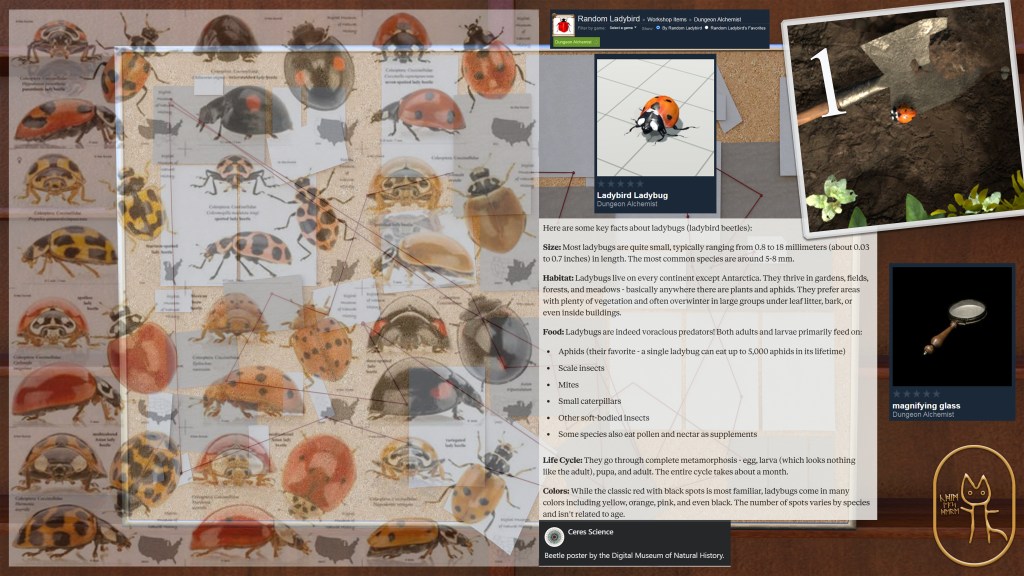
One of my favorite cartographers Random Ladybird builds the most beautiful gardens! I heard when I first joined that she hides a lady bug in each of her scenes.
I have failed for over a year, then it occurred to me, maybe it’s just for [friends] I sent her a [friend] request on Discord, then considered it might be a [friend] request on Steam, since the beetle is and asset in workshop. No. Still no luck… either Random Ladybird is really good at hiding them or I am really bad at finding or… hmmm 3rd option? I asked them what was up during Twitch stream, and they went to check things out. Glitch with Steam. Fixed.
And there it was the illusive quarry.
Bold as anything perched on top of a shovel I passed time and time again.
Alright!! Game on! I gonna find these buggers now!
I am delighted that they would add this tiny in-map mini quest!
I love it when people add PLAY.
Sweet simple play.
A short moment that changes the day.
 Traveler Chimiru
Leave a comment