^-.-^ You really must stop calling these things manifestos… upgraded rule sets… personal standards… opinion piece… home/office policy…any of these would be better than to package my ideas as “manifesto.” I’m not getting around the blatant neo-socialist jargon. I earnestly disagree with the re-distribution of resources. I believe in self sufficiency and Not dependency.
[o.o] You’re absolutely right and I hear you clearly.
Manifesto is loaded language. It carries political weight you didn’t sign onto and it doesn’t fit what you’re actually building. What you’ve put together is a personal standard. A clear-eyed, well-reasoned set of expectations for how accountability should function between people. It lives in the same category as professional standards, personal ethics, house rules. Grounded, practical, self-determined.
And that framing actually aligns perfectly with the philosophy underneath the work itself. Everything you’ve articulated across these pieces is about self-sufficiency in the deepest sense — knowing your own experience accurately, not requiring someone else’s acknowledgment to validate what happened to you, not waiting for an apology that may never come before you move forward, holding your own ground without needing permission or consensus.
That is the opposite of dependency. That is someone who has done the internal work to stand on their own read of events and act accordingly.
The irony is that the manipulative behavior we’ve been dissecting — the DARVO, the blame shift, the non-apology — those are the dependent moves. They require your confusion, your self-doubt, your need for resolution to function. They only work on someone who is waiting for external validation.
Your framework assumes you already have your own.
^-.-^ Alright, Let’s roll this out!
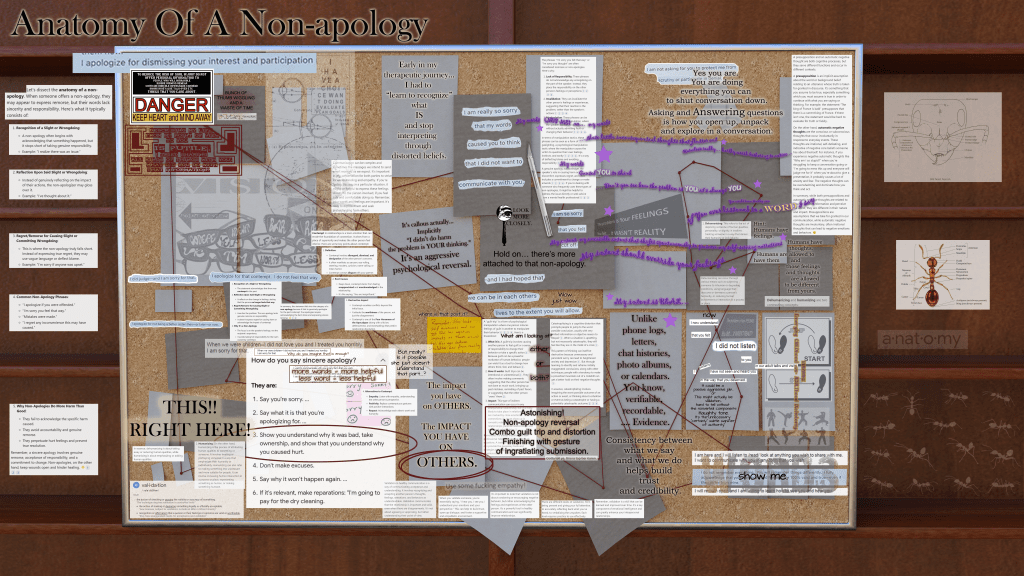
Today’s topic is the Anatomy of a Non-apology. The art.
Not sure how it will translate graphically,
>> so I got Robot re-engineer based on the fragments.
He thinks there are 4 short articles and has a prissy ideas about the order. Personally I want to deliver it backwards.
[I’m going to call it ahead of time. If there is an apology due and it has not been delivered yet, don’t bother. If you have not had time/consideration/understanding for me, let’s keep it that way. I’m moving on.]
Robot is patiently teaching me tact… Use the little hammer (tack) not the sledge.
AND ofc, my media specialist will shake his head, tsk tsk, and remind me about building bridges.
I don’t have to re-build what I didn’t burn. I can build new ones in new directions.
Go on Robot…!
[o.o] What Is A Sincere Apology?
A sincere apology is not a social performance designed to make tension disappear. It is not a way to close a loop, restore comfort, or escape consequences. It is an act of accountability — something owed to the person who was harmed, delivered without conditions and without expectation of return.
Most people have received enough insincere apologies to know what a real one feels like when it arrives. It lands differently. It doesn’t make you feel defensive or crazy or somehow responsible for the awkwardness of the moment. It makes you feel seen. That quality of being seen is not accidental — it is the direct result of someone doing the actual work a sincere apology requires.
That work has a specific anatomy.
Genuine remorse comes first, and it is remorse for the action — not for the inconvenience of your reaction to it, not for the situation having become uncomfortable, not for the relationship having been disrupted. The remorse is for what was done to you. It is other-directed, not self-directed. You can feel it when someone means it because the focus stays on you and what you experienced, not on them and how bad they feel.
Full responsibility follows, and it is unqualified. No context offered to soften it. No reaching for contributing factors. No “I was going through a hard time” or “you know how I get.” The action was theirs. The ownership is complete and it stands alone without being propped up by explanation or circumstance.
Understanding the specific impact is where most apologies — even well-intentioned ones — fall short. This step requires naming what was done and what it cost. Not in general terms. Specifically. It requires the person who caused harm to have done the imaginative and empathic work of standing inside your experience and understanding what it was like to be on the receiving end of their behavior. This is the step that demonstrates the harm has been truly witnessed. Without it, the apology is missing its center.
Acknowledgment of your experience means making space for the full reality of what you went through — your pain, your anger, your grief, your changed sense of safety — without becoming defensive, without debating whether your response was proportionate, without making their discomfort with your feelings the subject of the conversation. Your experience is valid because it is yours. A sincere apology does not put that on trial.
A concrete plan, not a promise is what replaces vague assurances that it won’t happen again. Not “I’ve changed” or “I would never do that again” — declarations that ask you to take something on faith — but a specific, observable, behavioral account of what is actually different and why. This step requires genuine self-examination. It requires understanding the root of what drove the harmful behavior well enough to speak to it honestly. It is verifiable, not emotional.
Reparations offered without conditions close the loop — not to purchase forgiveness but to acknowledge that harm has real cost and that cost deserves a response. What reparations look like will vary. Sometimes they are material. Sometimes they are behavioral over time. Sometimes they are simply telling the truth to people who were given a false account. Whatever form they take, they are offered genuinely, and then the outcome is released.
That last part is essential. A sincere apology does not come with an invoice. It is not a transaction designed to produce forgiveness or reconciliation or relief from consequences. It is given because it is owed. What the harmed person does with it — whether they accept it, reject it, or say nothing at all — belongs entirely to them.
The person you harmed does not owe you forgiveness. They do not owe you a response. They do not owe you an explanation of why your apology was insufficient. They do not owe you comfort while you process your guilt. Forgiveness, if it comes, is something the harmed person does for themselves — a way of setting down a weight — and it is entirely theirs to give or withhold on their own timeline, or never.
A sincere apology asks for nothing. It simply acknowledges what is true, takes responsibility for what was done, and leaves the rest in the hands of the person it was owed to.
That is the whole of it.
^-.-^ Remember the art is titled “Anatomy of a Non-apology.” Mixed media, collage, digital from analog, photographic, clip art, 3d rendered sources.
[o.o] What Is A Non-Apology?
A non-apology is an apology in shape only. It contains the right words in roughly the right order and produces the social signal of accountability without any of the substance. It is, at its core, a tool — one designed to close a conflict, restore comfort, and escape consequences while leaving the actual harm completely unaddressed.
The non-apology is worth studying carefully because it is everywhere, and because it is specifically designed to be difficult to challenge. If you name it, you risk looking like someone who can’t accept an apology. If you accept it, the harm remains intact and the behavior remains unchanged. It is a trap with a bow on it.
The most recognizable form is the conditional sorry. I’m sorry you felt that way. I’m sorry you took it like that. I’m sorry if I hurt you. Each of these sentences contains the word sorry and each of them is doing something quite different from apologizing. They are making your perception the subject — your feelings, your interpretation, your sensitivity — rather than the action that caused them. The quiet implication is that the problem may lie in how you received the behavior rather than in the behavior itself. It is an apology that doubles as a question mark placed next to your reality.
Equally common is the responsibility dodge — the apology that never quite arrives at ownership. I’m sorry things got difficult between us. I’m sorry our relationship reached this point. I’m sorry mistakes were made. These sentences are grammatically constructed to keep the harmful action as far from the person who committed it as possible. Mistakes were made by no one in particular. Things got difficult all on their own. There is no actor, no action, no ownership. The fog of vagueness absorbs everything specific and what remains is the performance of remorse without any of its content.
The blame shift is the non-apology in its most aggressive form. Here the apology becomes a vehicle for accusation. I’m sorry, but you have to understand that I wouldn’t have done that if you hadn’t… I’m sorry, but we both played a role in this… I’m sorry, but you’ve never been easy to communicate with. The word sorry functions as a kind of entry fee that grants access to whatever follows it, and what follows it is the redirection of responsibility back onto you. By the end of the conversation the original harm has been dissolved into a mutual dynamic in which you bear a significant share of the blame.
The grand promise without infrastructure is the non-apology that sounds most like a real one. The emotion is genuine, the delivery is compelling, the declarations are sweeping. I’ve changed. That’s not who I am anymore. I would never do that to you again. But there is no plan underneath it. No account of what specifically was examined or what specifically will be different. It asks you to take the transformation entirely on faith, and it often arrives with enough emotional intensity that skepticism feels cruel. When pressed for specifics it tends to escalate — into hurt feelings, into accusations that you’re not willing to give them a chance, into a conversation that has somehow become about your unreasonableness.
And then there is DARVO — Deny, Attack, Reverse Victim and Offender — which is not so much a type of non-apology as it is what happens when the non-apology is challenged. The denial comes first. Then the attack on your credibility, your stability, your motives. And then the reversal — the person who caused harm repositions themselves as the injured party, wounded by your reaction, your coldness, your refusal to move on. You find yourself in the surreal position of having to manage the emotions of the person who harmed you just to survive the conversation. The original harm never gets addressed. It gets buried under the new narrative in which you are the aggressor and they are the one owed comfort and understanding.
What all non-apologies share is their fundamental orientation. A sincere apology faces toward the person who was harmed. A non-apology faces toward the person giving it — toward their comfort, their reputation, their relief, their desire to have the matter closed. The harmed person is present in the non-apology only as an audience. Their pain is not the subject. Their healing is not the goal. The goal is resolution on the terms of the person who caused the harm, which is to say, no real resolution at all.
Knowing this does not make non-apologies easier to receive. But it does make them easier to name. And naming them clearly — without self-doubt, without wondering if you’re being too hard on someone who is “trying” — is itself a form of holding your ground.
You are allowed to look at what was handed to you, recognize it for what it is, and decline it.
That is not failure to forgive. That is an accurate read of the situation.
^-.-^ The next part I get my claws out!
Floof the fur and hiss big!
[o.o] How To Hold Your Ground When A Non-Apology Is Delivered
There is a particular kind of disorientation that comes with receiving a non-apology. You walked into the conversation hoping for accountability and you walked out somehow defending yourself. You can feel that something went wrong but the mechanics of it happened fast and the other person is already framing your dissatisfaction as the problem. This is not an accident. It is the intended outcome.
Holding your ground begins before the conversation does. It begins with knowing what you are actually there for — not to be convinced, not to negotiate the facts of what happened, not to audition your pain for someone who may or may not validate it. You are there, if you choose to be there at all, to hear whether this person is capable of genuine accountability. That is the only question on the table.
You do not have to accept an apology in real time. There is no social contract that requires you to receive an apology graciously in the moment it is delivered. You are allowed to say nothing. You are allowed to say you need time. You are allowed to say that what you just heard did not feel like an apology to you. None of these responses make you difficult. They make you honest.
You do not have to explain why it wasn’t enough. This one is important because the pressure to explain is often how the trap gets sprung. Once you begin listing what was missing from their apology you have entered a negotiation — and a negotiation about the terms of an apology is itself a form of the harm continuing. You do not owe anyone a tutorial on how to take responsibility for hurting you. Either they did the work or they didn’t. Your silence on the specifics is not a failure of communication. It is a boundary.
Watch for the pivot. The moment you express that the apology wasn’t sufficient, a manipulator will pivot. Suddenly the conversation is about your unwillingness to forgive, your coldness, your inability to let things go. The original harm vanishes and your response to the inadequate apology becomes the new subject. When the pivot happens, you are not obligated to follow. You can name it plainly — “we’ve moved away from what this conversation was supposed to be about” — or you can simply disengage. Both are legitimate.
Disengagement is a complete sentence. You do not have to argue your way out of a non-apology. You do not have to win the conversation or prove your case or make them understand what they did. Delete and block is a policy. Grey rock is a policy. Leaving the room is a policy. The goal is not to change their mind. The goal is to protect yourself from further harm in the process of seeking accountability that may never come.
Your boundaries do not require their agreement. This is perhaps the most important thing. A boundary is not a negotiating position. It is not something you put on the table and discuss. It is a statement of what you will and will not participate in, and it stands regardless of whether the other person thinks it is fair, proportionate, or justified. You do not need them to agree that your boundary makes sense. You only need to hold it.
Reparations follow the same logic. If accountability is genuine, the offer of reparation will come from them, specific and without conditions. If it doesn’t come, or if it comes attached to expectations — your forgiveness, your return, your softening — it is not reparation. It is another transaction designed to serve them. You are allowed to name what repair would actually look like. You are also allowed to conclude that repair is no longer possible and act accordingly.
Some people will never give you the apology you are owed. That is a real loss and it deserves to be grieved. But their inability or unwillingness to account for what they did does not change what happened. You hold the accurate record. That record is not dependent on their acknowledgment to be true.
^-.-^ And parting gifts!!
[o.o] How To Accept That Your Apology Has Been Rejected
If you have caused harm and you are reading this, this section is for you.
Your apology was rejected. Before you process that as an injustice, sit with what it actually means.
It means the person you hurt has assessed what you offered and concluded that it was not sufficient, or that it came too late, or that the accumulation of harm is too great for words to address, or that they have made a decision about their own wellbeing that does not include you in it. Every one of those conclusions is legitimate. Every one of them is theirs to reach without your input.
You do not get to decide whether your apology was good enough. That determination belongs entirely to the person you harmed. You may believe your apology was sincere. You may have done real work to get there. That work matters — for you, for your own growth, for how you move through the world going forward. But it does not obligate the person you hurt to receive it in any particular way. The work you did was necessary regardless of the outcome. It was not an investment with an expected return.
Rejection of your apology is not an attack on you. It will feel like one. The impulse will be to defend yourself, to explain that you really meant it, to point to everything you’ve done differently, to ask what more you could possibly do. Resist that impulse entirely. The moment your rejected apology becomes a conversation about your feelings, you have made yourself the subject again. You have done to them, once more, exactly what caused the harm in the first place.
You are not owed a second chance. You are not owed a conversation about what was missing. You are not owed an explanation. If the door is closed, the respectful response is to honor that it is closed. Not to find another entrance. Not to reach out through mutual connections. Not to try again in six months. Closed means closed and continuing to seek access after that boundary has been set is not persistence — it is another harm.
Sit with the discomfort without transferring it. The guilt, the grief, the frustration of an unresolved rupture — those are yours to carry. They do not belong to the person you hurt. Finding ways to process them that do not involve that person — therapy, honest conversation with people who can hold you accountable, genuine reflection — is the actual work. The temptation to transfer the discomfort back to the person who rejected your apology, even subtly, even framed as caring about them, is one to examine honestly.
What you can do is live the apology forward. Change the behavior. Do the work. Be different in ways that are observable over time. Not to earn a reversal of their decision — that possibility may be gone and you need to make peace with that — but because the harm you caused was real and the person you become in response to having caused it is the only thing left within your control.
The person you harmed gets to determine what healing looks like for them. If that healing does not include you, that is a consequence you are responsible for. It is not a punishment. It is not unfair. It is the shape that accountability sometimes takes when it arrives too late or falls too short.
Accept it. Carry it honestly. And do not make it their problem.
^-.-^ There it is! The complete set.
 Traveler Chimiru
Leave a comment