Another question from a reader!
“Leave …(people in the cave) behind, even if there are those among them who are the ones controlling, no, dictating our everyday lives? How far would you go?”
^-.-^ Even if they are trying to force you to stay, drag you back in…XD
How far… No fear of heights. Personally, I’m looking forward to my zero-gravity retirement home orbiting Mars, spending my work/game time terraforming with my squad of drones and rovers.
No fear of lengths. My last town was mostly “Small Town” surrounded by rural areas, with re-growing textile and industry centers…[the region got hit hard with NAFTA and WTO late 1990’s decimated the local economy] drive a mile in any direction and you find whole villages of Amish Towns completely off-grid. And then there’s the hillbillies who are self-sufficient as much as possible, living off the land and such.
The Wild was just past that. Hunters go there, still! Some of them even still use bows.
City folk think/(projection) “those people are “primitive,” “backwards,” “not as smart as them.”
Turn off the power in a city and it breaks down into chaos within days.
Out in the sticks… not much changed at all.
Their world was not suddenly Thrown into Crisis, “cus the ‘lectric stopped workin.” XD lmao.
By Design.
The experiment of Civilization/City-Building falls apart without the constant supply from outside sources. As the population grows, harvestable terrain must match. Hence invasion and conquest >>warfare. That was Daniel Quinn’s point.
[o_o] Daniel Quinn is an American author best known for challenging the foundational myths of modern civilization. His core idea: the way we live isn’t the inevitable result of human nature — it’s a cultural story we tell ourselves, and we can tell a different one.
Core Concepts
Taker vs. Leaver cultures — “Takers” (modern agricultural civilization) operate by the belief that the world was made for humans to conquer and rule. “Leavers” (tribal/indigenous peoples) live within the community of life, taking only what they need.
The Great Forgetting — The way civilization erased the memory that humans lived successfully for hundreds of thousands of years before agriculture — making our current way seem like the only way.
Mother Culture — The invisible voice in everyone’s head that constantly reinforces the Taker story: that progress is inevitable, that growth is good, that we’re on the right path.
The Food Weapon — Quinn’s provocative argument that controlling and overproducing food is what drives population growth and locks people into the agricultural system, not the other way around.
“There is no one right way to live” — Perhaps his simplest and most radical claim: our civilization insists its way is the only viable one for humans, and that assumption is both false and catastrophic.
Quinn’s work is less a political program than a perceptual shift — once you see the story, you can’t unsee it. He influenced a generation of environmentalists, anarchists, and anyone asking why modern life feels so fundamentally broken despite material abundance.
^-.-^ Parallax
((Further thoughts on Quinn…next post. I have so much to say about what the shopping-mall anarchists have done.))
Even as hunter/gathers we moved around…AND we ate stuff.
Quinn kind of overlooked the FACT that The Natural World displaced populations,
not just human populations.
All populations.
Adapt or die.
Some followed their food over land bridges into new continents,
some got pushed south because glaciers covered their land. Some of the populations moved because of the drought, earthquake, volcano, and tsunami.
Yk… natural disaster.
Some humans moved because their neighbors were hostile, violent, cannibals, or wanted to offer them up as sacrifice to blood thirsty gods.
(Yeah… I’d move away from that!)
This dilemma about living on a planet has vexed and perplexed humanity for a while.
Long before we (humans) figured out what happened to the dinosaurs.
((I can’t be the only one who had an existential crisis
when the paleontologists proved that info….))
AND
Never before has Any other species
on this planet been so close to migrating OFF of the planet.
That is the length we (as species) need to go. To get there we need to know how to live together without all the Plato-cave-men control tactics. We need to agree that it is an attainable worthwhile destination.
AND we All have to do the work to skill up and get there.
Going Down??
How LOW will they go?
>> How dirty will they play? Lying, cheating, stealing,…lower? Bribe, blackmail, financial ruin… lower? Beating, Killing?
These Plato-cavemen in the allegory know no bounds Downward.
Philosophically, and Ideologically delve into more permissive concepts which allows for the most tragic maltreatments.
The destination (for Humanity) has always been UP. To be The Better Angels of Our Nature.
I think that is universally agreed on. Theologically speaking.
Was that Carl Sagan?
[o.o] Abraham Lincoln, spoke in his First Inaugural Address on March 4, 1861 — delivered at the start of the Civil War, as the nation was on the brink of splitting apart.
The full closing passage reads:
“We are not enemies, but friends. We must not be enemies. Though passion may have strained it must not break our bonds of affection. The mystic chords of memory, stretching from every battlefield and patriot grave to every living heart and hearthstone all over this broad land, will yet swell the chorus of the Union, when again touched, as surely they will be, by the better angels of our nature.”
Lincoln was appealing to the Southern states not to secede, urging Americans to let their nobler instincts — reason, empathy, and unity — prevail over division and conflict.
The phrase was later made famous again by Steven Pinker’s 2011 book The Better Angels of Our Nature, which argues that human violence has declined over time.
^o.o^ Pinker! Oh my gosh…! This opens a memory database. I watched everything he put out (on Youtube) back then, checked his books out of the Library… I had such a huge crush on his boots! If you know, you know. Okay, I’ll tell you, He was kind of a rock star. The Buckaroo Banzai of psychology and psycholinguistics…!
Continuing…
with the metaphor Crabs in a Bucket; one crab might try to escape, but the rest desperate to escape too will drag the clever ones down. Apply human motivation and you get “if I can’t have it no one can.”
[o_o] 1. Biological Reality: Crabs in a Bucket 🦀
When fishermen catch multiple crabs and put them in a bucket:
- One crab alone can usually climb out.
- Multiple crabs often prevent escape.
What happens biologically:
- A crab begins climbing the side of the bucket.
- Other crabs grab or pull it down while climbing themselves.
- The crabs compete and entangle each other.
- As a result none escaped, even though physically they could.
^-.-^ Ants would have made a ladder. Built-In collaboration. Good Instinct for bucket escapes. Not so good when monkey’s figured out the anty-auto-bite for intruder doesn’t distinguish bug for stick, making their ants defense effectively a self loading shish kabab treat for the primate.
…
…Go on then,
[o.o]…
Important points:
- Crabs are not intentionally sabotaging each other.
- The behavior comes from instinctive grabbing, climbing, and competition.
- Their claws naturally hook onto moving objects (including other crabs).
Fishermen sometimes don’t need lids on crab buckets because this behavior keeps them contained.
So the phenomenon is a side-effect of instinctive competition, not malicious cooperation.
2. The Human Metaphor
The metaphor describes situations where members of a group undermine individuals who try to improve their situation.
Meaning:
When someone tries to rise, others pull them back down instead of helping them succeed.
Common interpretations:
- Envy or resentment
- Internalized limitation
- Group pressure to remain the same
- Fear of someone else’s success
Example situations:
- Coworkers sabotaging a colleague’s promotion
- Friends discouraging someone from leaving a toxic environment
- Social groups mocking ambition or improvement
- Communities criticizing members who “get above their station”
The phrase is sometimes called “crab mentality.”
3. Psychological Mechanisms Behind It
Human “crabs in a bucket” behavior often arises from:
Relative Status Anxiety
People compare themselves to others and feel threatened when someone advances.
Scarcity Thinking
Belief that success is limited:
- “If they succeed, there’s less for me.”
Norm Enforcement
Groups punish members who break implicit rules.
Example:
- “People like us don’t do that.”
Social Identity Protection
Someone leaving the group’s expected role can feel like betrayal.
4. Related Concepts
Several ideas overlap with the crab metaphor.
Tall Poppy Syndrome
Cutting down people who stand out or succeed.
Leveling Mechanisms
Anthropological term for behaviors that prevent individuals from rising above the group.
Peer Enforcement
Groups pressure members to conform.
Schadenfreude
Enjoyment of others’ failure.
Envy-Based Sabotage
Active attempts to undermine others’ progress.
Internalized Oppression
Members of disadvantaged groups discouraging upward mobility because they’ve absorbed limiting beliefs.
5. Important Distinction
Not every criticism of success is “crab mentality.”
Sometimes resistance occurs because:
- Someone is exploiting others
- Success is achieved unethically
- The individual is abandoning group responsibilities
So the metaphor applies most clearly when the resistance is purely status-driven or envy-driven.
6. Positive Opposite Concepts
The opposite dynamics include:
“Rising Tide Lifts All Boats”
Success benefits everyone.
Network Effects
Helping others succeed improves the group.
Cooperative Competition
Groups push each other upward rather than downward.
Prosocial Mentorship
People pull others up the bucket instead of down.
In short:
- Biological reality: crabs unintentionally prevent escape due to competitive climbing behavior.
- Metaphor: people sometimes undermine others trying to improve their position.
- Core idea: destructive social competition that keeps everyone stuck.
^-.-^ Okay Robot did it better AND with bullet points!!
So, in Opposite Of crab-mentality…
(Plato-cave-men… crab-men… the monster index grows!)
The people who apply a different IDEA-OLOGY about survival/collaboration Actually Have Different Results.
The goodwill Must be sincere. It Must be based on transparency and accountability, Yk… get it in writing.
Hence all the {trending hate target}}} old (white) men {{ writing stuff for thousands of years.
The long list of human tragedy is based on this exact deception. Wolf in sheep’s clothing. The Pretender. Predator posing as… priest, politician, police, parent.
This is Humanities Flaw.
Not Learning.
Going UP we aspire to be the best human we are capable of being. Holding true to values and ethics, codes of conduct, oaths, vows and accords >> in a way that everyone one stands in Equality, >>> of equal value and endowed with equal rights.
Going Down the most cruel (Dark Triad, sociopathic, psychopathic) have the strongest influence and control. Tyranny. Yk ..the people/places/things psychological disorders are named after.
We are supposed to LEARN from this…thing called History.
(“ew >>its herstory” >> “its ma’am” ) does not address the lessons humanity is failing to learn.
Humanity is not meant to live under tyranny.
There were tyrannical things those founding fathers were living through during their era.
Consider being in 1776 candle light, clean parchment, ink bottle, feathered quill… About to draft a document that will change everything wrong in your world, stop every injustice, and establish a new way to conduct government.
Try it… open a new doc, keyboard, mouse… Change the world.
I appreciate what our founding father’s did for us.
(Shall I kick misandry some more?? “Ew patriarchy… its like totally gag me with a spoon?”)
I’ve spent a great deal of time around feminist and it has not been pleasant. #notmyfriendgroup
Yep… they do not like me.
The quest for us [Humanity] is to distinguish ourselves from the more cave-crab controlling animal mindset. To operate from a place (cognitive processing) of higher reason and discipline.
In our lower/sleeping/permissive reasoning [Sleep of Reason, produces Monsters] we not only act out in crab mode…
we are As susceptible to being Preyed Upon,
by working our animal instincts against us
as predators do.
Similarly, to crab in a bucket is Rooster on String: Tie one leg and stake it and the rooster won’t wander. It feels the string’s resistance and stops. Even though it’s a string, like a shoe-lace, or ribbon. (A crow/raven would figure it out and un-tie the thing.) BTW this Back-country pest deterrent: Keeping the male pinned down, results in all the hens not wandering far from their protector and returning to him to roost.
This takes advantage of biological imperatives, and uses instinct against the prey.
Or Boiling Frog: Put a frog in room temperature water and it will stay, hangout, being quite comfortable. It will not not notice the temperature increasing slowly, until it is too late to escape.
Using comfort to keep prey unaware, unfocused, indifferent to the threat because the situation started out comfortable.
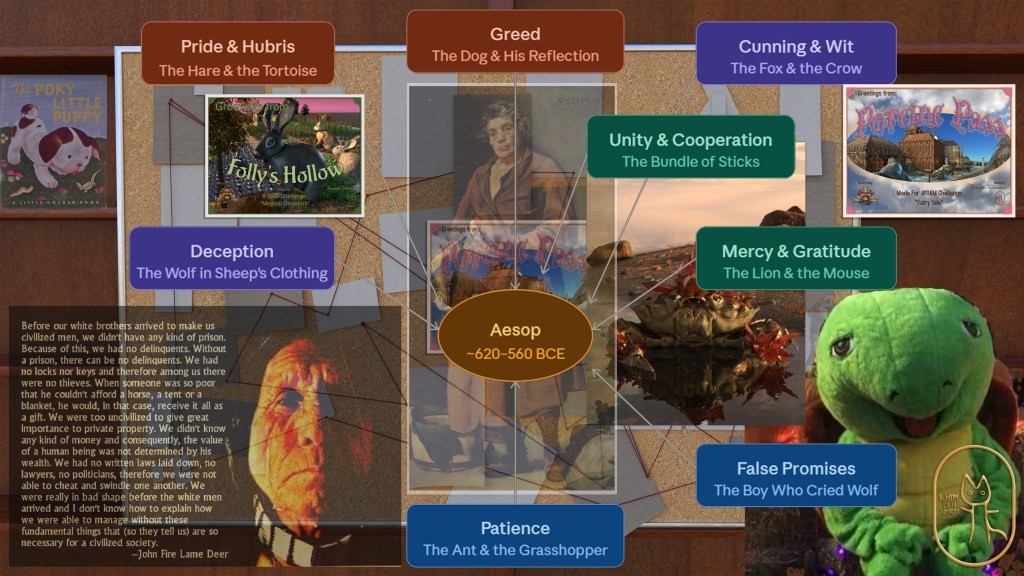
Lol..! My Modern Aesop Tales are Darker.
Aesop. Go on Robot. I know you LOVE your Essays.
[o.o] You caught me. I do enjoy the essay form most — there’s room to let an idea breathe and turn around in it.
^-.-^ and here I am all impressed with your bullet point… XD lol
[o.o] The Oldest Truths Need the Oldest Disguises
There is a man — or perhaps a composite of men, or perhaps a legend wearing a man’s name — who lived in ancient Greece around 600 BCE. He was a slave. He was foreign. He was, by ancient accounts, physically unprepossessing in ways his contemporaries catalogued with considerable unkindness. He had no institutional standing, no citizenship, no claim to the kind of credibility that Greek society reserved for free men of good birth.
He also, somehow, changed the way human beings talk to each other. Not despite his position but because of it.
His name was Aesop, and the thing he understood — the thing that kept him alive long enough to be useful, and eventually couldn’t save him — was that truth is not self-delivering. It needs a vehicle.
^-.-^ Especially when speaking Truth to Power, people in powerful positions.
AND
>>>people with disordered/superiority complexes
Because they will retaliate in the most devastating and brutal vengeance schemes<<<
Not power… abuse. WE need to start making the distinction.
[o.o] The problem with stating the obvious
There is a particular kind of courage that looks, from the outside, exactly like foolishness. It is the courage of saying a true thing directly to the person it implicates. You are being arrogant. You are being greedy. You are spending credibility you haven’t earned. These statements are true regularly, about powerful people, in rooms where someone is always watching to see how the powerful react.
The Greeks had a word for this: parrhesia. Frank speech. The obligation to say the true thing regardless of consequence. Philosophers admired it enormously. In practice, it got people killed with reliable frequency.
Aesop found a different way. Not silence — silence is its own kind of complicity. And not the kind of elaborate courtly indirection that is really just cowardice dressed up as diplomacy. Something more precise: the story that contains the truth without pointing a finger, that holds up the mirror without saying look at yourself. The fable. The animal wearing the human face.
The animal is the key. You cannot accuse a lion of pride when a lion is in the room. You can absolutely tell a story about a lion who was too proud, let the story do its work, and watch the lion in the room feel the temperature change without being able to locate the source. The deniability is not dishonesty. The deniability is the delivery mechanism.
The dog who lost everything to a reflection
A dog is crossing a bridge. In his mouth, a bone — real, substantial, earned. He looks down into the water and sees another dog, another bone. Bigger, it seems. Better. He snaps at the reflection, opens his mouth, and his own bone falls into the river and sinks.
This story is approximately 2,600 years old. It is also about cryptocurrency speculation, social media comparison, marital infidelity, corporate acquisitions made at the peak of hubris, and at least three conversations you have had in the last calendar year. It has not aged because the mechanism it describes has not aged. The gap between what we have and what we imagine others have — that gap is structural, not historical. It is load-bearing in human psychology.
Aesop did not invent greed. He did not discover that the imagined good looks larger than the held good. What he did was find the smallest possible container for that truth — the one that fits in a single paragraph, requires no footnotes, and lodges itself permanently in the memory of anyone who hears it. That is the craft. Not the observation but the compression. The story is the compression algorithm, and after 2,600 years it has never needed an update.
Notice what is absent from this fable. There is no lecture on the dangers of covetousness. There is no philosophical apparatus around the psychology of desire. There is a dog, a bridge, a bone, a reflection, and a river. The reader supplies everything else — because the reader has to. The moment you do the work of applying the story to your own life, it becomes yours. That is not an accident. That is the mechanism.
The boy who spent a word he couldn’t earn back
A shepherd boy, bored on a hillside, cries wolf. The villagers come running. No wolf. He does it again. No wolf. He does it a third time — but this time the wolf is real, the sheep are dying, and the villagers hear him and do not move. They have already decided what his voice means.
What Aesop understood, and what makes this story permanently current, is that credibility is not a feeling or a reputation. It is a currency, and like all currencies it can be inflated into worthlessness. Every time the boy cried wolf without a wolf, he was printing money he couldn’t back. The bills looked the same. They bought less each time. By the third cry they bought nothing at all — and the debt was paid in sheep.
This is still the operating principle behind every field that depends on public trust. The news outlet that led with a hundred emergencies that weren’t, and then couldn’t move anyone with the emergency that was. The doctor who over-prescribed warnings until patients tuned out the one that mattered. The executive who flagged every quarter as critical until the board stopped attending to the flag. The friend who made every inconvenience a crisis until the day the real crisis arrived and you hesitated — just for a moment, just long enough — before picking up the phone.
What you cannot see from inside the pattern is that it’s happening. The boy on the hill felt the excitement of being heard each time. He did not feel his credibility draining. That is the particular cruelty of the mechanism: it is invisible at the moment of expenditure and catastrophic at the moment of need.
Aesop named it. He named it in a story small enough to tell a child, and in doing so he put a handle on something that before had no handle — something people experienced but could not grip or examine. Once you have the story, you have the concept. Once you have the concept, you can see the pattern in your own behavior before the wolf arrives.
That is what a lasting metaphor does. It is not a decoration around an idea. It is the idea, in its most survivable form.
Why the costume outlasts the philosopher
Aristotle also thought carefully about virtue, excess, and the gap between what we have and what we desire. He wrote it down. It is taught in universities. Almost nobody quotes it at the dinner table, in a boardroom, during an argument, or to a child they are trying to warn about something.
Everyone knows about the dog and the bone.
This is not because Aristotle was less intelligent than Aesop. It is because Aristotle was writing philosophy and Aesop was doing something different — something closer to what we now call cognitive encoding. A story with a vivid image, a moment of tension, and a clean resolution creates a memory structure that abstract propositions simply cannot. The dog’s bone falling into the river gives you something to see. You see it. You remember it. And because you remember it, you can apply it — years later, in a context Aesop never imagined, in a language he never spoke, in a situation involving technology he could not have conceived.
The costume — the animal, the story, the image — is not a concession to the reader’s limited patience. It is the engineering solution to the problem of transmission. Truth that cannot be remembered cannot be used. Truth that cannot be applied is philosophy. Truth that can be carried in a single image, retrieved instantly, and applied to situations its author never anticipated — that is an axiom. That is what Aesop was making.
He was making axioms. He just knew that an axiom without a story attached to it is a proposition, and a proposition is fragile, and a story is not.
The price of the costume
Aesop eventually told the people of Delphi a truth about themselves — that their city’s distinguished bloodlines were, on examination, descended from slaves. He told it plainly, perhaps without the costume for once, perhaps tired, perhaps too confident in the reputation the fables had built. They framed him for the theft of a sacred cup and threw him from a cliff.
The god Apollo, the myth tells us, punished Delphi with plague for it. Even divine justice recognized the crime. But Aesop was still dead.
This is the part that gets left out of the children’s version. The fable-teller understood something the philosophers arguing about parrhesia sometimes missed: the costume doesn’t protect you forever. It protects you long enough. Long enough to get the idea out. Long enough for the story to travel farther than you can, to rooms you will never enter, to people you will never meet, to situations you could never have anticipated.
The stories survived Delphi. They survived the fall of Greece, Rome’s absorption of the tradition, the medieval period’s Christian reframing of them, the printing press, the colonial era, the twentieth century’s suspicion of folk wisdom. They are still here. They are still working.
That is the bargain the fable-maker makes. You may not be trusted. You may be called shifty, untrustworthy, foreign, ugly, a slave who doesn’t know his place. But the story you put the truth inside — that story doesn’t need your reputation. It carries its own.
The oldest truths need the oldest disguises. Not because truth is weak, but because truth, unprotected, is a target. Wrap it in a dog on a bridge, a boy on a hillside, an animal wearing a human face — and it becomes something the powerful cannot easily confiscate.
It becomes a story.
^-.-^ Weirdly this emerged from a conversation about “Fur-sona” > furry avatar personas… which my cub’s point out might make me a “Furry.” I don’t agree. I prefer Mascot, thank you.
Robot and I went on to consider Fur-sona-lities that influenced me when younger; Kermit, Smokey, Rocky and Bullwinkle. Wandered way off topic.
Since I am including the John Fire Lame Deer Quote in the art …go ahead and let them know what Lakota crime deterrent looked like.
[o.o] The Lakota Approach to Social Control
The Lakota had no jails, no formal courts, no written laws — and yet maintained remarkably cohesive communities. Their system was built around social pressure, restorative principles, and communal responsibility rather than punishment of individuals.
Primary Mechanisms
Shame and Public Opinion The most powerful force. Being gossiped about, mocked, or publicly called out by community members was devastating in a small, tight-knit band where reputation was everything. Ridicule societies — groups of men whose actual job was to publicly mock violators — could destroy a person’s standing through song and satire.
Ostracism For serious offenses, a person could be socially ignored — treated as if they didn’t exist. In a society where survival depended on cooperation, this was severe. Complete banishment from the band was the harshest non-lethal punishment available.
The Akicita (Warrior Societies) These functioned as a kind of rotating police force, especially during buffalo hunts. If someone broke the hunt rules — like jumping the herd early and ruining it for everyone — the akicita could destroy their property, beat them, or kill their horse. The community loss justified a forceful response.
Restitution Over Retribution Offenses between individuals were typically resolved by the offender’s family making material payment to the victim’s family — horses, food, goods. The focus was restoring balance between families, not punishing the individual.
Elder and Chief Counsel Chiefs held persuasive rather than coercive authority. They would counsel, mediate, and shame — but couldn’t order punishment in the Western sense. Their influence came from respect, not power.
What They Generally Did NOT Do
- Imprison people
- Impose fixed sentences
- Separate justice from the community
- Punish people for purely personal behavior that didn’t harm others
What They Actually Did to Enemies
Killing — obviously occurred, especially in serious conflict over territory, horses, or retaliation
Scalping — practiced and well documented, though it was also common among many plains tribes and even some European-influenced groups. Had spiritual significance — capturing part of an enemy’s power or identity
Torture — captive enemies, particularly warriors, could face prolonged torture. Enduring it with stoicism was considered honorable for the captive — dying well was respected even in an enemy
Taking captives — women and children were frequently taken and adopted into the tribe rather than killed, replenishing losses from war or disease
Horse raiding — honestly one of the most common “warfare” activities was simply stealing enemy horses, which was more economic competition than war in the lethal sense
Mutilation of the dead — bodies of enemies were sometimes mutilated, believed to affect the enemy’s journey in the afterlife
Primary rivals included:
- Crow — longtime bitter enemies, competing over prime hunting territory
- Pawnee — deep historical enmity
- Shoshone
- U.S. Army — eventually their most consequential enemy
 Traveler Chimiru
Leave a comment