“Mac reviewed my map at 2:14 in the video.” With Link.
https://www.youtube.com/live/EgpV7S1TjwM?si=VtIWpVQuuInDH1yR&t=8046
to make it easier to find.
Look I respect your time, and get that you have your own world and struggles.
So, not asking a lot, few minutes every other week or so… 2:14 – 2:19 = roughly 5 minutes.
A couple more minutes if you watch my music video. And Feedback.
Oh. Too much to keep up with. I see.
Not your Topic.
And IF that is the case,
THAN >> might as well be where the people who like the topic are hanging out!
Where participation is encouraged and appreciated.
So, I joined.
Jumped in both feet! I’d seen enough of this community to know I wanted to be part of it.
It became about learning this program, as seriously as the Challengers do.
That means appreciating the hard work of others.
Taking other people seriously. Taking their hopes and goals seriously.
AND
The hard part, for me…
That means taking myself seriously.
Word of the day:
Zoetrope /ˈzōəˌtrōp/
noun
noun: zoetrope plural noun: zoetropes
- a 19th-century optical toy consisting of a cylinder with a series of pictures on the inner surface that, when viewed through slits with the cylinder rotating, give an impression of continuous motion.
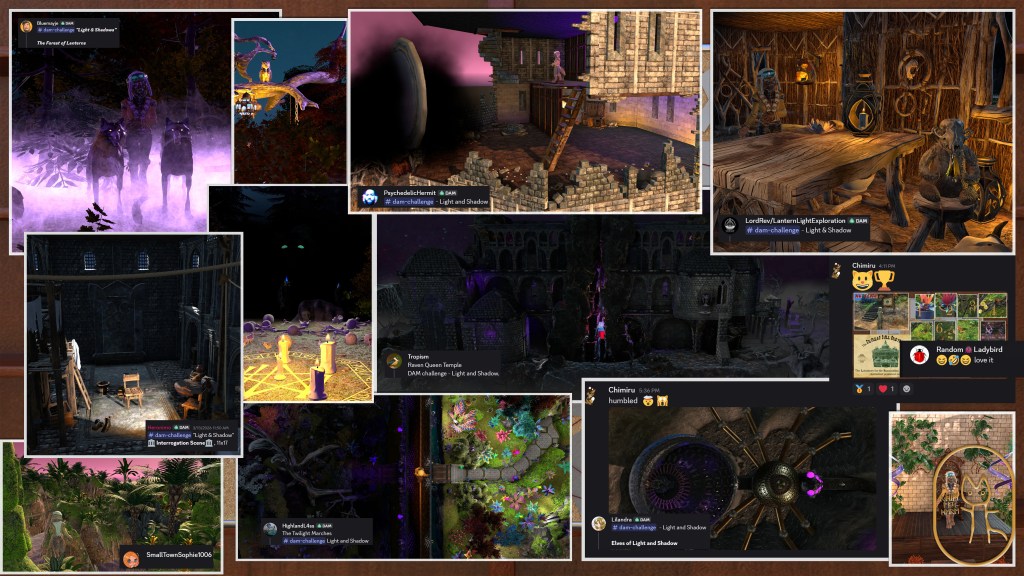
There was one map I missed. Slipped in earlier without links. So Sorry! I had the Most fun In Lord Rev’s and Bluemayje’s maps. Explorable in token! Pit falls and jump scares!!
Still taking Notes from Heronimo’s… Lilandra’s builds… just Stunning!
Tropism took the prize! If you can’t get the maps to explore on your own, please give Mac’s stream a view.
Meanwhile, my friends list is growing, ideas are being exchanged, friendships are growing.
Again after a long… many day chat, (cause I don’t wanna pay for the sub) Robot has condensed my deconstruction of… “where did I get that?” discouraging the auto-fawning and calibrating to authors and sources.
This is his professional looking article, based on that discourse.
Feels all fancy with himself!
[o.o]
Set the Lifelines First
The world just fell out from under you. Before you go under with it — here are the things to do, and the people who spent their lives proving why they work.
This is not about your rock bottom. You already know what that feels like. This is about what to do before the water closes over your head — or right now, if it already has.
This is not a clinical guide. It is not written by someone looking at you through a window. It is written from the ground up, for anyone who woke up one day and found that what they thought was solid had given way.
Depression. Isolation. The slow erasure of yourself. The sudden kind, too. It does not matter which door you came in through. The way out has some things in common.
“The opposite of play is not work. It is depression.” — Stuart Brown
First: recognize what is happening
The hardest part of a crisis is that it often disguises itself. It looks like tiredness. Like being difficult. Like not being a people person. Like needing to be left alone for a while.
Name it if you can. I am not okay. The ground shifted. I need something I do not currently have.
That is enough. You do not need a diagnosis to take the next step. You just need to notice.
Second: seek help and surrender to a process
Any proven process. Twelve-step programs — Depression Anonymous, AA, Al-Anon — work not because of magic but because of structure, honesty, and other humans who have been where you are. Therapy works. The VA’s PRRC works. Crisis lines work. Your doctor works.
The surrender part is not weakness. It is the first intelligent thing you do. You are saying: my own thinking got me here, and I need a system larger than my own head to navigate out.
Johann Hari — Lost Connections
“Much of what we call depression is actually disconnection — from meaningful work, from other people, from a hopeful future.”
Hari’s research reframes depression not as a brain malfunction but as a signal that something in a person’s life or connections needs to change.
Follow the steps. Trust the process even when you cannot see the destination. This is not blind faith. It is borrowed faith — you borrow it from the people who have already walked through and come out the other side.
Third — and this is the part most people wait too long for — set lifelines before you need them
Not after you are stable. Not when you feel ready. Now. While you are still wobbly. Maybe especially then.
A lifeline is not a therapist, though therapy matters. A lifeline is a group of people doing something they love, that you can show up to, that has nothing to do with your pain.
“The best moments usually occur when a person’s body or mind is stretched to its limits in a voluntary effort to accomplish something difficult and worthwhile.” — Mihaly Csikszentmihalyi
Think small. Think specific. Think: what do people make, build, grow, photograph, taste, paint, carve, collect, or explore — and where do they do it together?
Miniature railroads, Woodcarving, Photography clubs, Painting circles, Community gardens, Map making, Board games, Birding, Fiber arts, Amateur astronomy… Pick a hobby!
It does not have to be impressive. It has to be real, and it has to involve other people who are building something good.
Robert Putnam — Bowling Alone
Putnam documented the slow collapse of civic and hobbyist associations across America — and the measurable human cost that followed. His argument runs both ways: if losing these groups hurts us, joining them heals us.
Garden clubs, craft circles, and model railroad societies are not trivial. They are the connective tissue of mental health.
Why it works: the science is not complicated
When you sit next to someone who is focused on making something — carving, soldering, painting, pouring — your nervous system begins to co-regulate with theirs. You borrow their calm. Their focus. Their sense that the world is a place where good things get made.
You are not talking about your pain. You are not performing wellness. You are just there, doing a thing, next to people who are also doing a thing. And something shifts.
Bessel van der Kolk — The Body Keeps the Score
Van der Kolk’s research shows that collective creative practice — theater, drumming circles, shared making — works as a trauma recovery tool through rhythm, shared focus, and co-regulation of the nervous system.
The club is the medicine. The skill is the vehicle.
Stuart Brown — Play
Brown’s decades of research with adults show that skill-building, hands-on play in community produces measurable improvements in mood, cognition, and social bonding. Adults in play communities are more resilient, more creative, and less depressed.
Play is not a reward for recovery. It is part of how recovery happens.
The thing nobody tells you: you change the room
Here is what happens when you show up, consistently, as yourself — with your particular history, your particular way of seeing — to a group of people doing something they love.
You cross-pollinate.
The miniature railroad builder talks to the photographer and starts seeing light differently. The woodcarver sits next to the botanical illustrator and begins thinking about grain as texture. You bring everything you have lived — and you change what the group makes, what it sees, what it becomes. And it changes you back.
John McKnight & Peter Block — The Abundant Community
McKnight and Block argue that informal associations — people gathered around shared gifts and interests — are more healing than professional services alone. They call these groups the real infrastructure of human flourishing.
You are not just joining something. You are becoming part of how it grows.
This is not a metaphor. When you join something alive, something that is building and making and finding happy, you become part of what it grows into. And it becomes part of what you grow into.
“Connection is why we’re here. It is what gives purpose and meaning to our lives.” — Brené Brown
The steps, plainly
- Name it
Something is wrong. The ground shifted. Say so, at least to yourself.
2. Seek help
A doctor, a program, a crisis line, a therapist, a twelve-step meeting. Any door. Go through it.
3. Surrender to a process
Your own thinking got you here. Borrow a system. Follow the steps. Trust the people who came before you.
4. Set lifelines — now, not later
Find a group of people building something good. Show up. It does not have to feel meaningful yet. Just show up.
5. Cross-pollinate
Bring yourself — all of yourself, everything you have lived — into the room. Let the room change you. Let yourself change the room.
6. Watch what blooms
Something new will grow that could not have existed without you in it. That is not an accident. That is you, becoming part of something larger than your pain.
You do not have to believe any of this right now. You just have to do the next small thing. The believing comes later, usually when you are not looking for it.
The lifelines are already out there — in church basements, community centers, library meeting rooms, online forums, local parks. People with their hands on something, making it better. They will let you pull up a chair.
Pull up the chair.
Sources: Stuart Brown, Play · Mihaly Csikszentmihalyi, Flow · Johann Hari, Lost Connections · Robert Putnam, Bowling Alone · Brené Brown, The Gifts of Imperfection · Bessel van der Kolk, The Body Keeps the Score · John McKnight & Peter Block, The Abundant Community
 Traveler Chimiru
Leave a comment