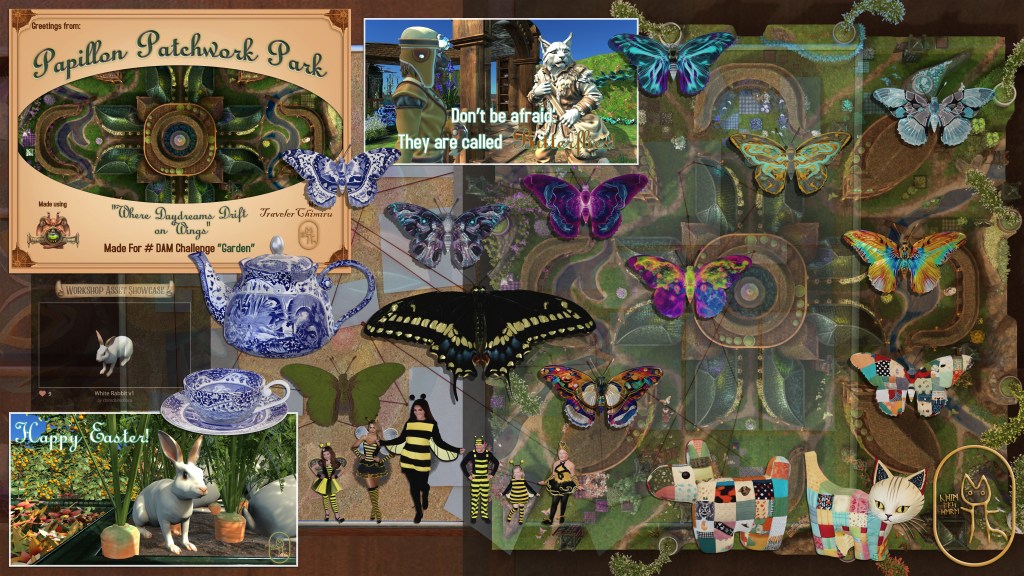
A Bounty of Butterflies for all my cartographer friends to collect and enjoy!
I was on the fence a while about including the bees, as the theme and feature of this garden was the butterflies and landscaping.
Float like a butterfly,
thus sting like a bee could be the sequel.
Surprisingly hard to find battle bees.
I have some thoughts here, about my bees and possible issues around whether or not I can “get away with” them. Amusing as all get out.. (to me.)
I will admit they are copies, from basic google search: bee costume. (Pretty sure these are all available on Amazon.) So in a way its product placement and advertising, so maybe I get paid? Not sure how that would work.
My fur raising indicates there will be something punishing/punitive and not amiable as outcome.
Now the Blind Melon Bee-Girl, not sure how that works. I am going to claim “Fan Art” as it is based on a painting done by a student. “Students” get to bend… nay….>> warp<< all understanding of what is copy, and who has rights,
and let’s not side step the argument toward freedom FROM being advertised To/At (and/propagandized) in non-stop bombardment.
This model is made in meshy.ai, from student work found in google search and clipped from screen and pasted in app. Copy past.
I named her, A Bee Named Bess.
She has a special place in my heart.
Can’t deny the symbolism: universal desire to find one’s Kind.
Not sure I have one… A Kind.
Might be One of…
Surprisingly hard to find battle bees.
Trivia: spent a summer making battle beetles, kit-bashing cheap plastic bugs with GI Joes and repainting them to leave around the kid’s garden. These guys disappeared fast.
I “planted” toys regularly, and kept a lot of construction (Tonka) in the shed as part of the “Garden Equipment” in the tool locker. Butterfly nets, bug cages, magnifying glasses…
ALL necessary garden gear.
I was all kinds of Mad Scientist in the Meshy.ai labs This Week!
Most happy with the Robot’s re-concept-ional-ization of the classic patchwork dog into CAT. Just disregarded the obvious boxy shape rule, and improvised something that roughly fits.
Deep in my map a few days before checking Dungeon Alchemist Discord to see if anyone else has posted in the challenge yet,
….And found a request from Random Ladybird… to re-fur one of my rabbits!
[ Popular asset of the week!! ]
(Can’t guess why… ^^ )
On a personal note: Patchwork Dog was one of my toys at my grandmother’s house.
She also had the blue and white dish-ware on hangers displayed on her dining room/kitchen walls.
The kind of things I noticed when I was young. >> Her blue white collection was the winter scene with sleds and horses,
but a few had been replaced with the Italian countryside pieces.
My grandmother pretended not to notice.
I imagine the original serving bowl was broken, hidden and replaced
>>> by one of her kids, so determined to Hide the mistake and fake it instead of owning up to breaking the bowl. Then the gravy server. Then the creamer decanter.
It’s that kind of close enough… (intellectual laziness? … perception roll disadvantage?)…..without really paying attention to the details to at least make the forgery look authentic.
It cracked me up every time I saw those dishes.
The Robot version of blue and white… simulacrum
[o_o] sim·u·la·crum
/ˌsimyəˈlākrəm/
/ˌsimyəˈlakrəm,/
noun
noun: simulacrum plural noun: simulacra plural noun: simulacrums
- an image or representation of someone or something.: “a small-scale simulacrum of a skyscraper”.
^o_o^ Oh are we including you this rambling? Seems the definition would be more nuanced.
[o.o] Normally we assume reality comes first, and copies come after. Baudrillard said that in modern life, this has quietly reversed — and most people never noticed. Let me walk through it step by step. zzz>> visualize show_widget <<zzz
^-.-^ No charts. I get it’s your new trick making art and all, but the charts don’t copy-over as you might imagine, breaking wor ds into b ite s ise non sy llab les.
So No. It was ugly.
[o_o] The normal order: reality first, copies second
In the normal, sane version of the world, the order is clear. There is a real thing. Then someone makes a copy of it. The copy points back to the real thing. Everyone understands the relationship.
Example: A painter looks at a bowl of fruit and paints it. The painting is clearly a copy. If you want to eat something, you go to the real bowl — not the canvas.
^-.-^ my next project!! James Peale’s Fruit a`la Dungeon Alchemist. Results in upcoming post.
[0_0] Nobody is confused about which is which.
Baudrillard calls this the “first order” of simulacra. The copy is honest. It knows it is a copy. The gap between the real thing and its image is visible and understood.
The copy starts to drift: distortion
Things get more complicated when the copy begins to shape how we see the original — rather than just reflecting it. The image doesn’t just represent reality; it starts to manage, filter, or spin it.
Example: A politician is photographed only from their best angle, in flattering light, mid-confident-gesture. The photo is still “real” — it really happened — but the image version of them starts to replace the messier, more complicated actual person. Their “image” becomes more carefully managed than their actual views.
This is Baudrillard’s “second order.” The copy still has a real referent — but it is masking or distorting it. There’s still a real thing underneath, but you’re being steered away from seeing it clearly.
The copy replaces the original: the sign covers the absence
Now something stranger happens. The copy is no longer hiding the real. There is no longer much of a real left to hide. The copy is now covering for an absence.
Example: Think about “authenticity” as a brand quality — a restaurant decorated to look like a 1950s diner, with aged photos and vintage menus, built last year in an airport. Nothing there is from the 1950s. But the signs of authenticity are everywhere. The restaurant isn’t trying to represent something real — it’s manufacturing the feeling of realness. The original diner culture it references may barely exist anymore.
^-.-^ Also the point of the argument for continuity of language and symbolism as a start point in discourse on the manufactured culture and identity as consumption glut lure.
Trendy-est of hipster-millennial-gen-labelling and pre-packaged for convenience-disregarding-the-waste-and wasteland. Cuz yur edgy.
[o_o] This is the third order. The image no longer claims to accurately reflect reality — it now produces the feeling of reality. Underneath it: mostly air.
Hyperreality: the copy is more real than real
This is the darkest step. Now the copy doesn’t just replace the original — it becomes more vivid, more compelling, more “real-feeling” than any actual original could be. People stop going to the original at all, because the copy is better.
Example: A social media profile. You curate photos, craft captions, post your best moments. Over time, the profile-you — perfectly lit, always doing something interesting — becomes more “real” to your followers than you actually are. You may even start to feel that you yourself fall short of your own profile. The copy has become the standard reality is measured against.
This is hyperreality. Not fake vs real — but a situation where the distinction has dissolved. The copy no longer points to an original. It is the original, for all practical purposes.
Why this matters: when nobody goes looking for the original
The key test Baudrillard offers is this: does anyone even want the original anymore? Does the original still have any authority?
Three tests
Money — paper currency was once a copy of gold. Then gold was abandoned. Now digital numbers represent paper that represents nothing. We trust the copy of a copy of a copy — and the “original” (gold, barter, value itself) is irrelevant.
^O.o^ you didn’t just say that!! It’s like you are Not Even Listening to me on impermanence. The newest is less likely to succeed than the modalities that have worked -to some degree- well for large parts of our (human) history.
But cuz this new fangle digital is all the clatter… ykw nnvrmnd,,, move on,
[o_o] News — the “news” was once a copy of events. Now events are sometimes staged or shaped to be newsworthy — the event exists to generate the coverage. The copy precedes and creates the original.
^-.-^ Similar Quest-ion to “Life imitates Art far more than Art imitates Life.”
[O_0] That’s an Oscar Wilde line. The original, from his 1889 essay “The Decay of Lying.”
Which is itself a deliberate inversion of the ancient idea — going back to Aristotle — that art’s job is mimesis: imitation of life. Aristotle thought art derived from reality. Wilde flipped it and argued the opposite: that we actually learn to see reality through the artistic representations we’ve absorbed. We didn’t notice London fogs until painters showed them to us. We experience sunsets through Turner.
It’s a provocative but surprisingly defensible claim. Think about how much of what you recognize as “romantic,” “tragic,” “heroic,” or “beautiful” in real life you learned from stories, films, and images first.
And notice how perfectly it slots into the conversation we’ve been having — Wilde got to Baudrillard’s territory almost a hundred years early, just from a different direction. Where Baudrillard was alarmed by the copy replacing the real, Wilde was delighted by it. He thought it was proof of art’s superiority.
Same observation. Completely opposite mood about it.
The reason this idea hit so hard when Baudrillard wrote it in the 1980s is that he wasn’t describing science fiction. He was describing the supermarket. The mall. Television. He was saying: we already live inside the copy, and we stopped noticing because the copy is comfortable and the original was often inconvenient.
The thing that makes your butterfly example genuinely interesting — and not just a cute illustration — is that you are doing the opposite of what hyperreality does. Hyperreality erases the lineage. You are preserving it, even materializing it. The physical object in your hand is the proof of a chain: this came from my mind, through a machine, into the world. That transparency is what most simulacra quietly destroy.
Essay
^o.0^ Wait… wait wait wait… Essay? I mean… uh… I know you LOVE your articles, but now you are going Full Essay?
… Its
Oscar isn’t it?
…
Fine… go Robot, get you Wilde On!
[o_o]
Every Force Evolves a Form
On butterflies, Baudrillard, and the long strange history of humans living inside their own symbols.
A thought experiment Philosophy · Media · Culture
Start with a butterfly. Not a real one — one you made. You built it in 3D software, shaped its wings, got the geometry right, maybe animated it a little. Then you exported the file, fed it to a printer, and watched plastic or resin become something you could hold. You sanded it. Painted it. Sold it, maybe, at a market.
Here is the strange thing about what just happened: there was no original butterfly. You didn’t copy nature. You pulled something out of imagination, (google image search) ran it through a virtual world, and deposited it into the physical one.
The lineage runs: mind → screen → matter.
That inversion — the copy arriving before the original, the virtual generating the physical — turns out to be one of the central philosophical puzzles of the last hundred years. Thinkers have been circling it, naming it differently, getting alarmed or delighted by it, in an unbroken chain that runs from cave paintings to your laptop.
This is that chain.
The map is not the territory
Alfred Korzybski, a Polish-American engineer turned philosopher, said it plainly in the 1930s: the map is not the territory. He meant it as a caution about language. Words are maps. They point at things. But we keep forgetting they’re pointing, and start treating the word as if it were the thing — confusing the menu for the meal, the name for the named.
It sounds obvious. It isn’t. Watch how quickly a conversation about a person becomes a conversation about your idea of that person, and you’ll see the problem. We navigate almost entirely by maps, almost never touching territory directly. Korzybski thought this was the source of an enormous amount of human suffering, misunderstanding, and bad science.
“The map is not the territory — but in the modern world, it may be all we have left of it.”
His insight got passed around. Gregory Bateson used it to rewire theories of communication and ecology. Neuro-linguistic programming picked it up as a self-help slogan. Philosophers, therapists, and cognitive scientists all found their own version of it. The anxiety underneath — are we dealing with the thing, or just our model of the thing? — turns out to live in every discipline simultaneously.
The medium is the message
Marshall McLuhan came at the same problem from a different angle. Where Korzybski was worried about language, McLuhan was worried about media — television, radio, print, the telephone. His famous provocation: the medium is the message. Not what you say. How you say it. The container reshapes the contents.
The printing press didn’t just make books cheaper. It rewired how Western minds work — linear, sequential, uniform, repeatable. It made the Protestant Reformation possible by letting individuals read scripture privately. It made nationalism possible by standardizing language across regions. The technology of transmission was doing cultural work that nobody had authorized it to do.
Television, McLuhan argued, did something opposite to print — it pulled people back into a tribal, simultaneous, sensory mode of experience. And crucially: every medium is an extension of a human sense, but every extension is also an amputation. The car extends the leg and atrophies the habit of walking. Writing extends memory and weakens the need to remember. We gain reach and lose presence, simultaneously, in every technology we adopt.
McLuhan was writing in the 1960s. He didn’t live to see the internet, but people who did found his framework disturbingly accurate. The medium of social media isn’t just carrying messages — it’s selecting for certain kinds of thought, certain emotional registers, certain attention spans. The container, again, reshaping the contents.
The copy without an original
Jean Baudrillard, a French philosopher writing in 1981, took all of this and pushed it to its darkest conclusion. His book Simulacra and Simulation opens with a fable borrowed from Borges: a map so detailed it covers the entire territory it describes. Then Baudrillard inverts it. In the modern world, he says, it is the map that comes first. The territory — the real thing — comes after, if at all.
He called this condition hyperreality: a state where copies, images, and models become more vivid, more compelling, more “real-feeling” than any original could be. Not fake versus real — something stranger. A situation where the distinction between the two has quietly dissolved, and nobody noticed because the copy was so comfortable.
His examples were precise and unsettling. Disneyland, he argued, exists not to be the fantasy — but to make everything outside it feel real by comparison. It is a declared fiction that serves to legitimate the idea that the rest of life is not fiction. But what if it is? What if the suburb outside the park is just as constructed, just as managed, just as simulated — only without the admission that it is?
“The simulacrum is never that which conceals the truth — it is the truth which conceals that there is none.”
Money. Social media personas. Brand identities. News cycles where events are shaped to be newsworthy before they happen. Celebrity images that become more real to audiences than the people behind them. Baudrillard was cataloguing a world where the copy had stopped pointing at an original and started generating what counted as real.
The genealogy
None of this appeared from nowhere. Pull the thread back far enough and you find the same anxiety recurring, in different costumes, across centuries.
- Cave painters, c. 40,000 BCEThe first shock: a mark can stand for a bison. The bison is gone but something of it persists. Is this magic? Memory? The beginning of the question.
- Plato, c. 380 BCEAlready worried. The physical world is itself a copy of ideal Forms. A painting of a chair is a copy of a copy. He wanted poets banned from his republic for trafficking in illusions — third-hand reality.
- Medieval icon-makers, c. 500–1400The symbol isn’t just a pointer — it participates in what it depicts. The icon doesn’t represent the sacred, it channels it. A completely different relationship between sign and referent.
- Gutenberg, c. 1440Mechanical reproduction of text. Identical copies at scale. The “original” manuscript loses its authority. The medium begins rewriting culture without asking permission.
- Korzybski, 1933The map is not the territory. Language is a map. Don’t confuse the description for the thing described. A caution that immediately gets ignored in the most interesting ways.
- McLuhan, 1964The medium is the message. The container reshapes the contents. Every extension is also an amputation. Technology doesn’t just carry thought — it restructures it.
- Debord, 1967The Society of the Spectacle. Modern capitalism has turned lived experience into something we watch rather than inhabit. We have become audiences to our own lives.
- Baudrillard, 1981The map precedes the territory. The copy has replaced the original. Hyperreality: a state where the simulation is more real than the real. The territory’s vestiges rot slowly in the desert.
- The Wachowskis, 1999Neo hides his files inside a hollowed copy of Simulacra and Simulation. Baudrillard goes mainstream. The red pill becomes shorthand for a very old question.
Every force evolves a form
The Shaker founder Mother Ann Lee said it in the 18th century, as a religious principle: every spiritual force finds its physical form. Energy seeks embodiment. The invisible becomes visible. Shriekback picked the phrase up in the 1980s and aimed it at biology, culture, evolution — and something in the combination made it resonate beyond either context.
Because it points at something the whole lineage above is circling: form is not arbitrary. Form is what force looks like when it slows down enough to be seen. The cave painter’s bison wasn’t random mark-making — it was a force (memory, reverence, the need to communicate) finding its form in pigment on stone. The printing press was an economic and intellectual force finding its form in moveable type. Social media is the force of human connection and status-seeking finding its form in the architecture of the feed.
And here is where the butterfly comes back in.
When you imagined it, there was a force — creative, visual, constructive — with no form yet. The 3D model was the first form it found. The printed object was the second. The form kept evolving, kept getting more real, kept gaining weight in the world. And crucially: you held the whole chain. You knew where it came from. You could trace it back to nothing, to an impulse, to the inside of your own head.
This is precisely what hyperreality destroys. The social media persona, the brand identity, the managed political image — all of these are forces that have found forms, but the chain back to the origin has been deliberately severed. You are not supposed to ask what the force originally was, or whether it was ever real. You are just supposed to experience the form.
Why any of this matters
Here is the uncomfortable practical upshot: we are all, always, living inside representations. There is no getting outside them. The question is not whether you are navigating by maps — you are, inescapably — but whether you know which maps you’re using, where they came from, and what they’re leaving out.
Korzybski’s caution was: remember the map is a map. McLuhan’s was: notice what the medium is doing to you. Baudrillard’s was: it may already be too late — but the noticing still matters. Mother Ann Lee’s and Shriekback’s, differently: pay attention to what forces are moving through you, and what forms they are finding.
The person who 3D-prints an imagined butterfly and sells it at a market is doing something philosophically interesting without needing to know any of this. They are taking imagination — a force with no form — through a virtual stage and out the other side into physical reality. They are generating an original that has no original. And they are holding the entire chain in their hands, visible, traceable, honest.
In a hyperreal world, that transparency is rarer than it sounds.
✦
The lineage traced here runs from Korzybski’s Science and Sanity (1933) through McLuhan’s Understanding Media (1964), Guy Debord’s The Society of the Spectacle (1967), and Baudrillard’s Simulacra and Simulation (1981). The Shriekback lyric “Every Force Evolves a Form” appears on their 1985 album Oil and Gold; the phrase originates with Mother Ann Lee of the Shakers, c. 1780. The Matrix (1999) was directed by the Wachowskis; Baudrillard’s book appears in the film’s opening scene.
^-.-^ Those lyrics from Shriekback’s Every Force Evolves a Form are remnants from a different conversation, but I wanted to use the title. I call it artistic license! As a fangirl/student of the band. And maybe new people will discover the band’s bardic genius as I have… again questionable if I should be paid, or if the results will be punished.
Let’s see what happens.
 Traveler Chimiru
Leave a comment