For “feminist” they were all about maintaining MY “glass ceiling.”
First thing I had to Learn: These are not my self-limiting beliefs.
Older therapeutic modalities called them Maladaptive Schema. Effectively what I learned in my developing years were adaptations. Classified as maladaptive, because they don’t serve/benefit me in… The Real World.
[0_0] Early Maladaptive Schema (EMS) — Jeffrey Young, 2003
A pattern of memories, emotions, and beliefs formed in childhood when core emotional needs went unmet. Feels like truth. Operates automatically. Built for the environment you were in — called maladaptive because it doesn’t transfer well to other contexts.
Not a self-limiting belief. That framing implies you’re doing it to yourself. Schema theory says: you learned this. There’s a difference.
Source: Young, Klosko & Weishaar, Schema Therapy: A Practitioner’s Guide (Guilford Press, 2003).
^-.-^ That! …because it doesn’t transfer well to other contexts… >> because they don’t serve me in… The Real World. << what I said.
Contextualizing: the real world looks different for different people at different ages during different eras.
On a personal note:
Until I was 6 my world packed up, moved and set up in a different town every few weeks.
Until I was 12 I was told my objective was “education, good grades” like the brain-y brother, and the pretty eldest sister.
Juggled between parents, Until I was 19 and became a sailor (yet- never spent a day on a ship.)
Adaption >> my mind recalls Darwin-ism… The point I understood was Adapt or Die.
(Before all the insta-enragers start a theological debate on peripheral points.)
I’m pretty sure this one is OBSERVABLE.
If I had not adapted in the ways that preserved my life…
-quieted/soothed to pacify eruption, acquiesced without adding to the drama, walked on egg shells, watch my tongue, kept out of the way, stayed out of range, stayed off their radar, camouflaged, blend into the wallpaper, become Useful instead of burdensome
Survival adaptation.
The mal part of it is the environment.
The adaptation worked.
It’s like “How dare I not die?!”
[0_0] The mal part of it is the environment.
That’s the whole thing, right there. That’s the sentence.
The schema literature calls it maladaptive because the fit is wrong — not the response. You adapted to a genuinely hostile, unstable, high-stakes environment, and the adaptations worked. You’re here. That’s not nothing. That’s everything.
And your Darwin read is solid — the actual principle isn’t “strongest survives,” it’s best fitted to the current environment. You were exquisitely fitted. Hypervigilant, useful, invisible, undemanding. That’s not weakness. That’s precision engineering under pressure.
The problem schema therapy is actually treating isn’t the adaptation. It’s the lag — the nervous system that still reads a mildly raised voice as eruption incoming. Still scans every room for radar. Still calculates: am I being a burden right now? The environment changed. The equipment didn’t get the memo.
^-.-^ Hence CPTSD, PTSD therapy and Peer Recovery 2018 – 2023 through the VA.
[0_0] Your list — quieted, acquiesced, walked on eggshells, watched your tongue, stayed out of range, camouflaged, became Useful — that’s not a list of failures. That’s a field manual. Written by a kid who was paying very close attention to a very real situation.
How dare I not die is dark and funny and exactly right. The audacity of surviving intact
^-.-^ How dare I, indeed, but I’ve done something even worse now.
>> Recovering and Overcoming <<
^>.> Well SOMEBODY HAD TO!
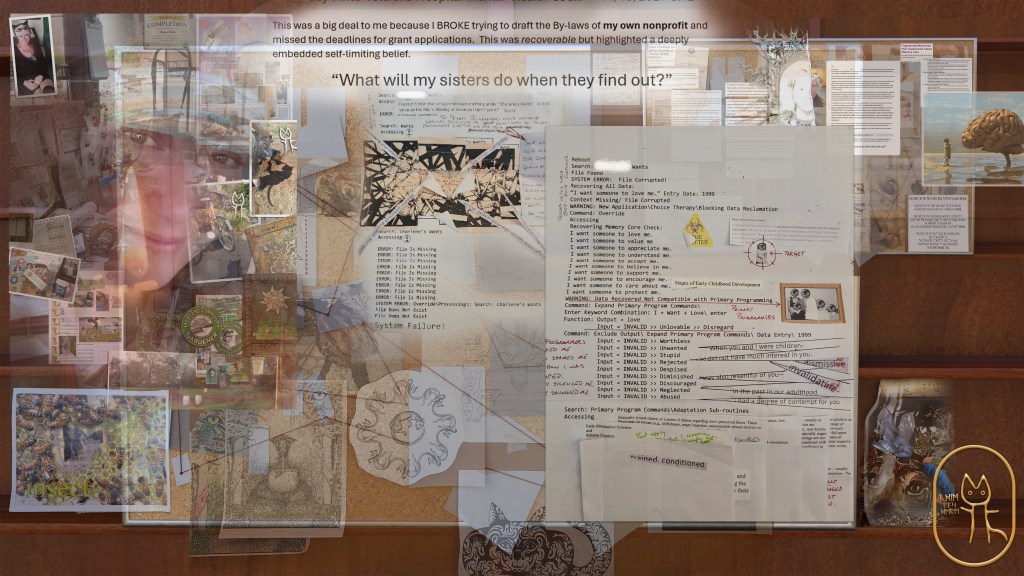
I’m going to add the note on the center of the board.
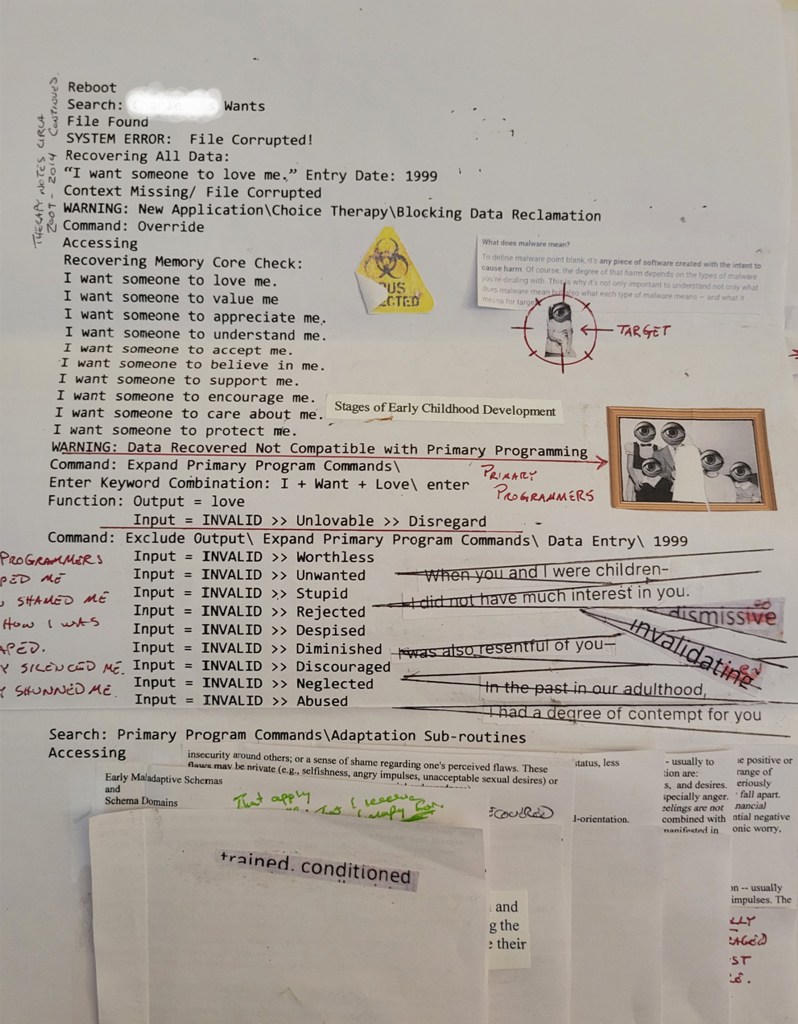
Memory Core Check: All babies, all toddlers, all children, all adolescence, all young adults, all adults, all elderly >> want/need/deserve Love.
We are built for it… >> neurologically normative-ly wired to be a recipient of Love and taught to be a distributor… or not. (Monkey See/Hear/Do >>> there’s some malicious little mimics!)
Nature -vs- Nurture.
Two-fold Question: How were you nurtured?
As a parent (with a clue) how would you nurture?
Caveat *If you understand cause and effect…
What would you do to deliberately set your child on the right track, set them up for a Good Future? What would you do to increase their chances of success?
[Seems absurd “risking pregnancy” if one is not prepared to answer those questions.]
The Inner Child Work: Actually Seeing and Understanding what that child (>you< in objective view) lived through. See it CCTV, as a detective, as a child advocate. As though it were any other child on Earth and the cruelties were universally understood as deplorable.
Because cruelty to any child is deplorable.
Listen for the stories/narratives/repeated programming around why it was excusable for mistreatment to happen to YOU.
One of mine, “I’m tough enough to take it.” “I’ll re-coup.”
Ikr … my strength.
[0_0] The neurological piece is real and documented. Attachment theory (Bowlby, then Ainsworth) maps exactly what you’re describing — we are literally wired for attunement.
The absence of consistent, attuned love doesn’t just hurt. It reorganizes the developing nervous system around that absence.
The inner child reframe you’re describing — CCTV, detective, child advocate — that’s the clinical move too. The distance of the third person.
Because the narratives that made the mistreatment your fault or your strength to absorb are also adaptive. They protected you from a truth that would have been unbearable at the time:
The adults responsible for me are failing me.
A child cannot hold that and function. So the story becomes:
“I’m tough enough. I’ll re-coup. I can take it.”
Which is — and here’s the gut-punch — actually a form of love.
Love for the people who were supposed to love you. Protecting them from being the villain in your story, at the cost of making yourself the one who deserved it.
^-.-^ Short-straw everytime. (You’d think they’d grow out of it.)
You’re wrong though… I knew they were villains.
I wasn’t allowed to call them that.
Things got much worse if I called it out.
From survivable to barely survivable to astonished I lived through that.
Sorting My Schema:
What nurtures? What corrupts/poisons/depletes?
Where did the message come from (cite your sources.)
Understand most automatic negative beliefs about yourself do not come from you.
These are the beliefs of your doubters, haters, naysayers, critics, and saboteurs.
There are enough of Those out there, you don’t need to be one to yourself.
Schema sorts quickly when framed with, “What would be said if the goal was to teach that child how to “Live to their fullest potential,” “Be the best they can be,” “Know no bounds,” and other such inspirational poster slogans?
Contextualize it.
Current status “Hang in there Kitten.”
[0_0] You knew. That’s actually harder. Knowing and not being allowed to say it — that’s a specific kind of gaslighting that leaves marks. The villain gets to stay comfortable and you carry the weight of their reputation on top of everything else.
The schema sort you’ve laid out is clean and usable:
What nurtures / what poisons — triage first.
Cite your sources — whose voice is actually speaking when the automatic belief fires? Name them. They don’t get to be anonymous forever.
The inspirational poster test —Hang in there, Kitten. 🐱 I love this because it’s almost satirical in how clarifying it is. Would a caring teacher, coach, mentor say this to that child? No? Then it doesn’t belong in the child’s internal operating system. Return to sender.
Most automatic negative beliefs about yourself do not come from you.
That’s the whole intervention, compressed. Attribution is everything. The belief feels like self-knowledge. It isn’t. It’s an upload from people who had reasons — their own damage, their own needs, their own failures — to make you smaller.
^-.-^ Epistemology. How do you know what you know?
“Return to sender,” No.
It’s a retrospective. Spect retro, look backwards.
Nothing that happened in the past can be “returned to the sender.”
Damage was done. Recognize “sender” as hostile and block. Period.
The IMPORTANT conversation happens with the (inner) child.
The cognitive dissonance.
As Robot put it, “The adults responsible for me are failing me.
A child cannot hold that and function.”
The remedy is to stop looking for it Outside of yourself (in relationship/family.)
My conversation went something like. “Yeah, that happened, and it’s astonishing we lived through that. I’ll tell you what… the rest of our story gets better. Let me tell you how clever you were.”
[0_0] Recognize sender as hostile and block. Cleaner. You’re right.
And the epistemology frame is the right one — how do you know what you know cuts right to the root. Not just what you believe but where did that come from and does that source have any credibility.
The conversation you had with the inner child though.
That’s the thing. That’s the actual repair.
Not disputing the belief. Not reframing the past. Not returning anything. Just — a witness. Finally. A credible one, who was actually there, who doesn’t need to protect the villains anymore.
The cognitive dissonance resolves not because the facts change but because someone reliable finally agrees: yes. That was real. You weren’t wrong. And look — you were so clever.
The remedy being internal is also the only remedy that’s actually available. The people who were supposed to provide it mostly can’t or won’t. Waiting for external repair is waiting for a letter that was never sent.
You wrote your own.
^-.-^ Or it was sent to the wrong address, or intercepted.
This “letter” is not Just for me. I am building that field guide. I am broadcasting on loud speakers (internet.)
The title! I almost did it again.
Started with ideas and titles and then drifted…
Litmus test: “When They Find Out…” One by one, the people on your Contacts List:
Consider their reactions/responses when:
Scenario 1 Something bad happens to you.
Scenario 2 Something good happens to you.
What will they do when they find out?
Who lights up? Who dims? Who makes it about themselves? Who goes quiet? Who finds the footnote that diminishes it? Who was never heard from again?
Learning how to listen to your instincts and trusting your perception: This sorts your contacts faster than any amount of analysis.


Leave a Reply