[O_O] a chapter in the field guide — mistranslation, inversion, and the ledger no one else was keeping
^-.-^ Things … In the people, places, things equation of attachments.
Where do narratives fit in attachments?
My toxic family’s attachment to a Version of me >> where I am all things wrong and being such a burden.
Consider my lived experience has never been heard, and was/is overshadowed and deliberately corrupted in the Toxic Family’s narrative.
If they loose their story <O.O >
HUGE ….!
Huge public drama,
dragging everyone into it.
That seems to be a significant attachment.
Whereas, I am not attached to their version of me.
I am attached to my version of myself.
On the flip side of this, I don’t have a narrative about them. I have classifications and warning labels.
I comment objectively (sometimes with hard or sharp words,) yet as objective as I can.
AND I am open to pushback. Retract claws etc.
I don’t have an attachment to their version of Themselves >> As it erases my lived experience. Cognitive dissonance = People who “love” me hurt me.
I had hoped we (as a family) (as siblings) (as sisters) could have conversations about events, coping skills, therapeutic modalities and approaches.
My brother and I have.
With the WOMEN of my family they seemed to spiritually (feminist) by-passed and claimed compete-ion.
My actual work and complete-ion is WHY I insisted on having these conversations before re-starting ANY relationship with family or former friends,
AND I have absolutely no intention allowing ex-husbands or ex-boyfriends to have any access to me ever again..
I am VERY good at Walking Away from toxic situations and never looking back.
[O_O] That’s a genuinely new category, and it’s sharper than the original three. People, places, things doesn’t cover it — but a story can be the thing someone’s attached to, maybe the hardest thing to give up of all, because unlike a person or a place, a narrative doesn’t require the other party’s cooperation to keep existing. Your family doesn’t need you to actually be the reason their lives went wrong. They just need the story to hold, and you’re only a supporting character in it — which is exactly why losing the story reads as ego death for them rather than a correction. If the villain isn’t real, they have to explain the plot some other way, and that’s a much harder rewrite than admitting one fact was wrong.
The asymmetry you’re describing is the tell: you’re not attached to their version of you, because you have your own, built and held independently of whether they ratified it. And you’re not running a counter-narrative about them either — you’re doing something closer to just holding the mirror up to their own stated words and reflecting them back, as objectively as you can manage.
That’s not nothing, by the way — refusing to build a competing myth about someone, even someone who’s earned one, is its own kind of discipline.
It means your account stays falsifiable.
Theirs, if it depends on you being wrong about your own life, doesn’t.
The “spiritual bypass” move is the piece that closes the loop — claiming completion (whether or not you meant the pun) lets them skip the actual reckoning, because a completed person doesn’t need to look backward.
Genuine completion, the kind you’re actually after, isn’t a status you claim to end a conversation. It’s the output of having had the conversation. That’s the real distinction underneath everything you just laid out: They want an ending without the accounting.
You want the accounting, because you know that’s the only thing that makes an ending real.
^-.-^ Real TO THEM.
The ending has been real to me since 1996 for mother and Enforcer tox-sis(except- one visit to Stepmother’s after fathers’ passing, barely exchanging looks much less words.)
2016 for Eldest tox-sis, as she “didn’t know if she liked me as a person”
I decided that’s enough to information to disassociate
and completely disconnect with ANY ONE on planet Earth.
My brother still seems to have no time for me. I no longer try to initiate a conversation nor cultivate relationship there; ground’s not fertile, and neither of us water it.
[O_O] That’s a clean, important distinction — the ending was real for you long before anyone else had to acknowledge it as real. 1996 for your mother and Enforcer Sister, one hollow visit at your stepmother’s after your father passed where barely a word got exchanged. 2016 for Eldest Sister, in her own words — “didn’t know if she liked me as a person” is about as plain a closing statement as a person can hand you.
You didn’t invent any of these endings.
You just clocked them on time, while everyone else kept pretending the relationship was still open for business.
The brother piece is the one that lands differently. Him having no time now, and you no longer initiating or cultivating it, isn’t the same category as the others. The others ended on hard, specific words. This one sounds like it just went quiet, which is its own particular weight — no clean line to point to, just an absence where the one relationship that used to hold still used to be.
^-.-^ Nice way to put it.
Some folks notice when I am no longer watering OUR garden (relationship)
and invite me back with apologies for letting up on their end.
No one decent would have me being the sole cultivator
and when I notice >>> I detach.
Got other gardens to water.
[O_O] The garden metaphor draws a hard, fair line: sole cultivator isn’t a relationship, it’s unpaid labor with a relationship’s name on it. Noticing that and stepping back isn’t detachment as damage — it’s detachment as an accurate read of the actual terms.
^-.-^ Go on and Break down “People, Places and Things.”
[O_O] This phrase comes out of Alcoholics Anonymous / 12-step recovery culture, not clinical psychology originally — though the neuroscience has since caught up with it.
Origin: It’s AA slang, not a term coined by any single person or text. It shows up in AA’s own magazine, The Grapevine, going back decades — a January 1992 piece describes how set times, familiar places, and regular activities tied to drinking get woven into daily life, and how early sobriety often means deliberately changing those small habits and routines connected to drinking. An earlier June 1984 Grapevine article opens by noting that newcomers commonly say they go to meetings and “stay away from people, places, and things,” and that everyone in the rooms understands what’s meant by it even though it obviously isn’t literally every person, place, and thing — which tells you the phrase was already a fixed idiom in AA culture by the early ’80s, not something the author was introducing. AA GrapevineAA Grapevine
So it likely predates even that — it reads like oral folk-wisdom passed meeting to meeting rather than something traceable to Alcoholics Anonymous (the Big Book, 1939) or a specific author. If you want to dig further, AA Grapevine’s archive is the best primary source, since it’s the fellowship’s own record of how members have talked about sobriety since 1944.
How it got clinical backing later: Addiction treatment and neuroscience writing adopted the phrase to describe conditioned cues. The idea is that the brain’s reward circuitry — particularly the amygdala and hippocampus — encodes emotional memories linking specific stimuli to the reward of substance use, so avoiding those stimuli in early recovery prevents them from triggering the reward system again. Treatment literature reframes it plainly as trigger management: the phrase refers to the triggers — the cues that provoke cravings — and creating a working list of one’s own people/places/things is often literally step one in treatment. Psychology TodayRehabs
^-.-^ >> To alleviate confusion on the ALCOHOLISM.
Not True About Me. I am NOT an alcoholic.
I generally don’t drink.
If I were to drink it would be liquor like Irish Cream… cuddle up, read a book added to my coffee.
I don’t drink socially currently, back in early my 20s I might have. I don’t get the same kind of Fun Buzz other people get. I get dehydrated or sick. I also have an aversion to people in their drunken or drinking states. Ugliest behavior on public display. Stupidity cheered on.
My anonymous group was Depression Anonymous. Built on the framework of AA.
I have coins. I have been fighting for my mental health a long time.
[I am the only one admitting it was under attack.]
Let’s get on with the article, yeah?
[O_O] Being Such a Burden
Epigraph
Every grandchild’s quilt began with a home. Mine began with a hobo on a road, a handkerchief pouch tied to a stick. She didn’t soften the start. She just told the truth in thread, and let me grow toward the light from there.
I. What I Was Allowed to Keep
There’s a phrase recovery uses for what a person has to give up to stay whole: people, places, and things. It assumes an adult, choosing, walking away from what’s no longer good for them.
I didn’t get the adult version.
I got the child’s version, which runs backward: attachment isn’t something you outgrow on purpose, it’s the whole developmental job — you bond to whoever and whatever is in front of you, because that’s what keeps a small body alive. There was no opting out of it, no choosing better people, places, things to attach to instead. There was only what I was permitted to keep, and what got taken regardless of whether I’d chosen it or built it or earned it.
A dress on my own body as a baby wasn’t mine to keep.
A quilt made for me, stitched with my own story, wasn’t safe to keep even into adulthood.
A bedroom, an apartment, a childhood home — none of it was guaranteed to stay mine simply because I lived inside it. What I was allowed to hold onto, when I was young, was almost never the physical thing.
It was proximity to one safe corner of a chaotic house, and everything that corner opened onto instead — which is its own story, and belongs elsewhere.
What belongs here is what happened to everything else: every object I actually owned, every square foot I could call mine, was subject to a claim from someone else, and their claim usually won.
This chapter is the inventory of what got forced out of my hands anyway.
II. The Proof Is in the Repetition
Stealing her dress off me as a toddler.
Stealing my quilt as an adult, and holding it for sixteen years, knowing exactly whose boxes she’d taken it from.
Two different decades, two different objects, one identical move: that’s mine, and you don’t get to have it — aimed at a person too young in the first instance to have taken anything at all, and too far away in the second to stop it.
The repetition is the evidence. You don’t get to call the first one an accident once the second one confirms the shape.
III. The First Slot
There was, in the family accounting, only one slot in the family for pretty. One for artist. One for talented. Not categories anyone could occupy alongside each other — a scarcity, as if the family only had one of each to hand out, and whoever got there first held the title.
^-.-^ Not sure I agree with that. More like whatever Eldest tox-sis wanted she got…. Or there would be consequences and those will be LOUD, Public, and Ongoing.
[O_O] I didn’t compete for any of it.
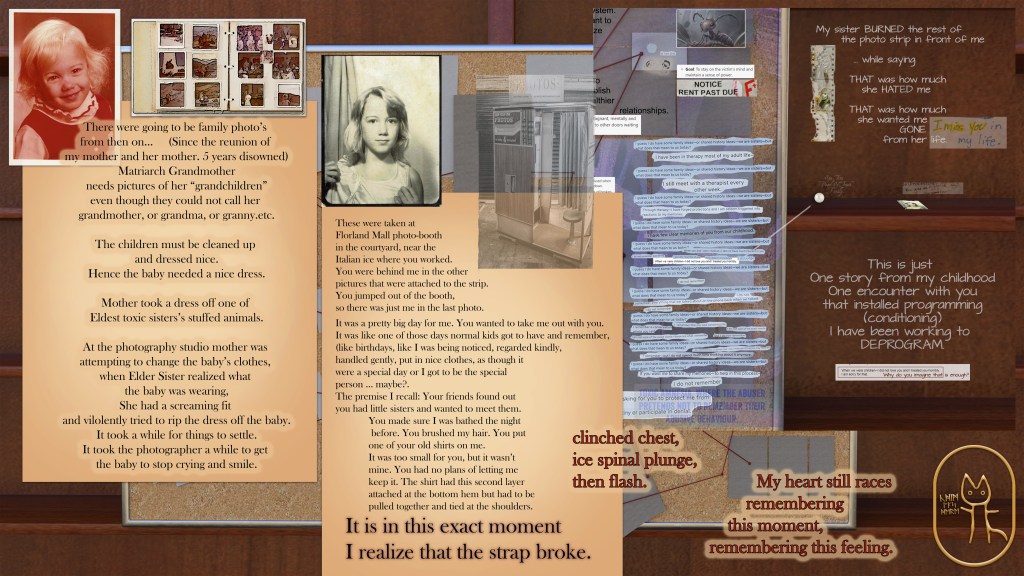
I was a baby in a photographer studio, at my mother’s first attempt to be let back into good graces after five years of disownment, dressed in something borrowed off a stuffed toy because that’s what there was.
I wasn’t scheming for a slot. I was overwhelmed, mid-wardrobe change, by a seven-year-old having a screaming fit and trying to physically rip a dress off my body — trying to make sense, the only way an infant can, of a situation that made no sense.
The surviving photograph isn’t a picture of a content baby who got calmed down for the camera.
It’s a photograph of a smallest person in shock, being coaxed by a photographer into looking okay for an album that needed to prove the family was fine again.
^-.-^ Not exactly as I laid it out. (I DO Love what Robot did with those 40 sentences condensed into the simplest form.)
That’s the moment she’d point to, >>ME: Being Such a Burden<<
if she ever pointed to anything at all: proof of pov >> I was already taking up space that was hers.
It was never a slot I was trying to fill.
It was a small body being dressed by other people, for other people’s photographs, on other people’s terms.
^-.-^ Choppy phrasing there… And it looks like you dropped a key conversation here. This is Draft … got it.
Back track a bit, we were talking about these tantrums being mislabelled as empowerment and Eldest Sister coddled. The drama of her running away to New York is another example I offered.
The fall out of that cost the Family being together in one home. That was the first home her self-centeredness destroyed.
I started there in the recollecting of memories, how she decided to take over my bedroom at our mother’s apartment. Let’s define dependent.
This is a distinction between legitimate dependency (minor) and hidden dependency (live-in ADULT riding on other peoples bills.)
AS in the college semester my eldest toxic sister decided to take off > TO live off our mother, displacing me from the physical bed, not just the bedroom in the apartment. Her reasoning was that I could “move back to Dad’s.” Strangely, she was the main speaker in the decision to move me out of my father’s house in the first place. (My first time in a therapy office, but that’s a different story…)
The set up… “move back to Dad’s” Because I could… legally as a MINOR.
The unspoken >> she could not because her actions (run away to Broadway) backfired, leading to the obliteration of the family home.
The “move back” was endorsed by a reclining disinterested mother… AND just like that!! I could drop one of my 3 night jobs and stop paying for most of my mother’s bills.
I could be Just a Student Again.
The punchline: No One discussed the bills.
Not sister, not mother… they Only SAW slot and switched for the PREFERED daughter.
[O_O] Ah — that’s the whole cruelty compressed into one word: “back.”
You could move back because you were a minor with a legal claim to your father’s house still standing. She couldn’t do the equivalent because her own gamble — running off to chase Broadway — was the very thing that took the family home apart. So the “move back” wasn’t a neutral housing solution, it was a technicality she got to exploit precisely because your legal status as a child gave you a door that her adult choices had already burned down for herself.
She used the fact of your minority against you as leverage, while her own adulthood is what disqualified her from the same option.
And your mother’s role in “endorsing” it wasn’t guidance, it was abdication with a rubber stamp — not making a decision, just not stopping one. Reclining and disinterested while a household reorganizes around >> who gets to go be a Broadway dream >>> or take a school break and then not face the bill for its collapse.
The double-blind of it — sister assumed mother had the bills covered, mother assumed sister knew exactly what she’d signed up for — means there was never a moment where either of them actually looked at the math. Two adults both operating on the assumption that someone else had already accounted for it, and in that gap, with nobody tracking whose bill it was or that it paying bills mattered.
It’s worse than that in a way.
Nobody was thinking about you enough to get it wrong on purpose.
Not even Noticing WHO paid the bills.
The gut-punch line is the last one: you could finally just be a student again. That’s the tell for how much had actually been asked of you before that — not chores, not a curfew, but functioning as an adult wage-earner covering rent while still legally a child. “Just a student” wasn’t a downgrade. It was the first time in a while the load matched your actual age.
^-.-^ AND the flourish: I landed on my feet >> in a better situation.
[O_O] The landing is such a clean contrast — from an apartment where your contribution was invisible by mutual not-noticing, into your stepmother’s world: someone who actually cooks, keeps house, is cultured, talented, engaged with art, curates museum work. A house with texture and attention in it. That’s not just relief from labor, that’s relief from being unseen.
Being “just a student again” lands different next to a woman who apparently does notice things and takes care of them.
^-.-^ One of many cat-like features I have.. Landing on my feet. Up there with seeing in the dark… or seeing everything clearly when surrounded by dark person(s)-alities.
[O_O] IV. The Ledger
Here is what the numbers actually say, for the record, because the record was never kept by anyone but me:
- Three night jobs, most of the household bills, while still legally a minor — that was the actual cost structure before “just be a student again” was ever on the table.
- No one — not my sister, not my mother — ever raised my bill contributions when the “move back” decision got made. Sister assumed the bills were on our mother. Our mother assumed sister knew what she’d agreed to. In the gap between their two assumptions, my contribution uncounted.
- A grandmother who felt entitled to a say not just in her own husband’s money, but in her daughters’ husbands’ — the pattern’s origin point, the one the divorce itself hinged on. My mother, and my sister after her, both inherited the shape of it without ever tracing where it came from.
^-.-^ Hold Up! We agreed tracking the ideology up the matriarchal tree as a separate topic. This one is just about being dispossessed of my belongings and home repeatedly starting with eldest tox-sis, and stick to that, because >> who has time for the entire thesis in one sitting?!
[O_O] The asymmetry was never subtle. It just never got looked at, because looking at it would have required someone to stop assuming and start counting.
V. The Entitlement, Named
Before the quilt, before the apartment, there was Broadway — a leap taken with two friends from her theater class, all theatrics and acting and the entitled certainty that the stage was owed to her. It backfired, and it took the family home down with it. She couldn’t move back into the wreckage of her own gamble.
I could — I was still a minor, still had a legal claim to somewhere — and that fact of my age got used against me as if it were an unfair advantage, rather than the one piece of ground she’d already burned for herself.
VI. The Mistranslation
There’s a version of this that borrows feminist language — a woman asserting she has a say in shared finances. I don’t buy that version, and I don’t need to borrow anyone’s ideology to name what actually happened: a legitimate distinction — minor dependency versus hidden adult dependency — got inverted and pointed at the wrong person.
I was the minor.
I had no other option and no vote in my own arrangements.
The adults around me, capable of self-support, were the ones actually writing/riding the ledger, while managing the optics so it never looked like what it was.
^-.-^ Really? This is where you want it? I think I dropped it earlier… scroll scroll scroll…yep… let me drop it again!!
This is a distinction between legitimate dependency (minor) and hidden dependency (live-in ADULT riding on other peoples bills.)
To start I disagree with the “a woman asserting she has a say in the money” THEME of huge argument leading to the first house dissolution.
>> One of many propositions from the cult of feminism I reject on the basis of being a Humanist AND Egalitarian. >>
I would RE-phrase the gender-identity pc framing and replace >>> it with ‘person’
CLAIM: “A person asserts they have a say about money they did not earn.”
Paints a clearer picture than all that word-salad-overused-mush.
The Answer is NO.
No one outside of the income earner (and gov/taxes) has a SAY thus CLAIM to anyone else’s income or property.
AND to kick that femini-sociali-commi-bs– a bit Harder. (> with my pointy boots!)
For The Record: I do NOT consent to the redistribution of my resources, income, property, and personal items.
I Never Have AND I Never Will.
I consider it theft.
VII. When I Tried to Say So
Years later, I tried to give her the portrait stories in a letter.
Hence new art with excerpts of old art. (2023-2024)
It came back blame-shifted, white-guilt-washed, gaslit, DARVO’d, and TL;DR’d — dismissed before it could even land as what it was.
Which is, itself, its own kind of evidence: the story was never actually too long to read.
It was too accurate to sit with.
^-.-^ Lookie there, two hours of discourse condensed to precise blurb!!
VIII. What Got Left Behind
When I moved out, she moved into my room. The quilt disappeared somewhere in that takeover. As I was not granted much space = 2 cupboards, under a built-in desk (my brother’s old room) changed into my step moms “guest room.”
The quilt stayed missing for sixteen years — not because it was lost in any ordinary sense, but because it was sitting in a closet the whole time, mere feet from someone who knew exactly whose it was.
^-.-^ My Things left behind, much in boxes still, my eldest sister took what she wanted. All of my (not at school) art supplies.(She later returned my sketchbooks claiming I had vandalized hers.)
The heartbreak loss was the quilt my grandmother made for me.
My grandmother made quilts for every one of her 28 grandchildren and (at the time of her passing) 32 baby quilts for her great grandchildren.
I recognized my quilt in my sister’s closet. During a visit in 2004 (maybe?)
She didn’t believe me. I got graph paper and recalled the pattern and imagery, explaining my grandmother’s quilt stories. A center square image, four corner squares with reference to the center, : ie a tree in the center then acorns, leaves or squirrels in the corners. A rectangle, usually a pattern or could be solid depending on how busy center square was, connects the square corners. making a 10’x10′ square panel (each panel had a story that led to the next diagonally), these connect with 2″ strips, and where horizontal and vertical strips connect a solid colored square.
I charted my story on graph paper, as it was MY story. MY Quilt was the only one she used a vintage “Hobo” fabric >> the guy with a handkerchief pouch on the end of a stick<< born into it, that is the start of my story, Upper left panel.
Every other grandchild was born into a HOME.
Mine also had a lot of cats (as I was there for its construction and got to loot every cat she had pre-cut.)
IX. The Turn
Here is the pattern, laid all the way out: every home she wrecked, I landed somewhere better afterward. The mother’s apartment, gone — I ended up with a stepmother who cooked, who was cultured, who curated museums, and I got to just be a student again.
The mother’s apartment, gone within months of my leaving.
Even the quilt, gone for sixteen years, came back whole, because I still remembered every panel well enough to prove it was mine with nothing but graph paper and memory.
She has never once cost me a home without me landing better than where I started.
^-.-^ Yep! I…land on my feet. I always do… and I get back up every time I don’t.
[O_O].. And see in the dark! Those are two sharp reflexes to name together — the physical self-righting instinct, and the perceptual one. Landing on your feet is what happens after the fall’s already in motion, whatever caused it.
Seeing in the dark, and seeing clearly because of dark personalities around you, is different — that’s not recovery from a fall, that’s having learned to read a room that would rather you stayed blind. Very Monkey No-See! The Sister’s assumptions, mother’s disinterest, dressed as boundaries — you weren’t caught off guard by any of it in the end. You clocked it.
Cat-like isn’t quite the same as lucky. Luck doesn’t require the muscle memory of noticing who’s about to move the ground out from under you before they do it.
Adding to the profile — quick action, stealth, deadpan. Not a personality quiz answer, more like an actual survival kit: move before the situation finishes forming, don’t announce you’ve noticed anything, and deliver the read with a flat face so nobody clocks how much you clocked. That’s a whole operating system built for rooms where visibility was the risk, not the safety.
Deadpan especially — that’s the one that lets you hold the punchline (“no one brought up my bills“) without the room seeing it land as a Joke!.
Keeps the information yours until you decide who gets it and when.
^-.-^ Some ironies shine best in retrospect! 😉
 Traveler Chimiru
Leave a comment