Real constraint vs Fear, Obligation, Guilt. (FOG)
And how much of that FOG was Conditioned via misery seeds, manipulation, and punishment.
[O_O] Yes. And this is where “choice” gets much more interesting than simply “you always have a choice.”
Because sometimes the choice is genuinely constrained. Other times, the person technically has choices but has been conditioned to experience certain choices as impossible.
That distinction is worth unpacking.
What am I choosing?
| Actual constraint | Conditioned constraint |
| “If I leave, I may lose my housing.” | “If I leave, I am a terrible person.” |
| “I cannot safely do this right now.” | “I must do this or someone will be angry.” |
| “I don’t have the money.” | “I am not allowed to want something different.” |
| “I have a legal obligation.” | “I owe them because they made me feel guilty.” |
| “Someone is physically dependent on me.” | “Everyone else’s feelings are my responsibility.” |
| “There are consequences I genuinely cannot avoid.” | “I am terrified of consequences someone trained me to expect.” |
| “I lack the necessary ability/resources.” | “I have been taught that I am incapable.” |
| “This person has actual power over me.” | “I still obey the imagined reaction of someone who no longer has that power.” |
That second column is fascinating because the constraint can become internal after the external enforcement is gone.
Someone doesn’t have to be standing there anymore.
The punishment has already been installed.
Fear
There is ordinary fear:
“This is dangerous. I should be careful.”
And conditioned fear:
“If I disappoint them, something terrible will happen.”
The second may persist long after the original danger has disappeared.
You can know intellectually:
“I am allowed to say no.”
while your nervous system is saying:
“DON’T DO THAT.”
So the question becomes:
Is this fear telling me about present reality, or is it reporting an old rule?
That’s a very different question from “Why am I so afraid?”
Obligation
There are genuine obligations.
I have responsibilities to people I have committed myself to.
But there is also manufactured obligation:
“After everything I’ve done for you…”
“If you loved me, you would…”
“How could you do this to me?”
“You know what this will do to me.”
“You can’t leave me like this.”
Now the person’s choice isn’t being discussed on its merits.
Their guilt is being used as leverage.
And if that happens repeatedly, eventually the person may stop experiencing the manipulation as manipulation.
They simply think:
“I have to.”
That’s the interesting part.
The word have can conceal an enormous amount of conditioning.
^-.-^ Good catch! My “I have to” is based on my value system.
[O_O] Guilt
Healthy guilt can say:
“I violated my own values. I should repair that.”
Conditioned guilt can say:
“Someone is unhappy with my choice, therefore I have done something wrong.”
Those are radically different.
One points toward your own code.
The other makes someone else’s emotional reaction the authority over your behavior.
And that’s where your earlier idea of having your own code becomes important.
Because a personal code gives you something to measure yourself against other than somebody else’s displeasure.
Did I actually do something wrong?
Or:
Did someone simply dislike what I chose?
Those are not equivalent.
And now the misery seed bank comes back into it
Repeated misery can condition these responses without anyone sitting down and consciously deciding:
“I am going to manipulate this person.”
The pattern itself can teach:
Hope → punishment.
Independence → disapproval.
Boundaries → anger.
Joy → criticism.
Disagreement → conflict.
Saying no → guilt.
Trying something new → ridicule.
Not participating in misery → accusation.
Eventually the person learns:
Don’t do that.
Not because they genuinely can’t.
Because they have learned what happens when they do.
And that’s where the question “What am I choosing?” becomes almost forensic.
You can ask:
What is actually stopping me?
Is it:
A material constraint?
Something genuinely unavailable, unsafe, illegal, unaffordable, impossible?
Or is it:
Fear?
What am I afraid will happen?
Obligation?
Who says I have to? What is the actual obligation?
Guilt?
Did I violate my values, or did somebody become unhappy with my choice?
Conditioning?
What reaction have I been trained to anticipate?
Punishment memory?
Am I responding to what is happening now, or to what used to happen when I did this?
That last question can be enormous.
Because sometimes the person who once enforced the rule is no longer in the room, but the rule is.
And then there is perhaps the most liberating distinction:
A choice can be difficult without being impossible.
You can say:
“I am afraid, and I’m choosing this anyway.”
“I feel guilty, and I’m choosing this anyway.”
“They may be angry, and I’m choosing this anyway.”
“I don’t know how this will turn out, and I’m choosing this anyway.”
That’s agency.
Not pretending there are no consequences.
Not pretending fear isn’t real.
Not pretending obligations don’t exist.
But separating real consequences from conditioned consequences, and then deciding which ones actually belong in the decision.
And I think that connects beautifully back to the Reality Therapy influence:
The question isn’t merely “Do I have a choice?”
It’s:
“What am I choosing—and what, exactly, has taught me to believe that I have no choice?”
^-.-^ That second question; That’s where the wounds become visible.
[o_0] Here’s what I’d add, mostly on the practical and mechanical side.
Real constraints have details; conditioned ones have tone of voice. A useful field test: a material constraint can usually be described specifically. It has numbers, dates, a named consequence, a mechanism. Example: “My lease ends in March and I can’t cover first and last month on another place” is a constraint with parts. A conditioned constraint gets vague when you push on it. “Something bad will happen.” “It would be wrong.” “They’d never forgive me.”
Ask “and then what, exactly?”
and it doesn’t elaborate; it just gets louder. It also tends to be urgent, absolute, and oddly younger than you. The feeling arrives at the age you were when the rule was installed.
^-.-^ Inner child wound.
[o_0] The rule can be read like a statute. When you hit a “have to,” you can interrogate it the way you would a law:
Who wrote it?
When was it passed?
What was it protecting against?
What’s the penalty clause?
Who enforces it now?
Has it ever been repealed, or did the legislature just move away and leave it on the books? That last one is the heart of the thing. A lot of these rules are still in force only because nobody ever formally struck them down.
The ledger has two columns, and we usually only count one. The framework asks what it costs to break the rule, but conditioning trains you not to count what it costs to keep it. Compliance has a running tax: energy, time, self-trust, the things you didn’t do or say or want. Fear shows you the one-time price of defiance in vivid color and the ongoing price of obedience in beige, so it’s worth making yourself look at the beige column.
The enforcer gets internalized, then outsourced. After the original enforcer leaves, the rule tends to get delegated. First to yourself: preemptive self-punishment, getting the criticism in before anyone else can. Then sometimes to new people who fill the vacant office, because a familiar enforcer feels safer than no enforcer. And sometimes the rule gets passed down, enforced on others. Asking “whose voice is this?” catches the first; noticing who you keep appointing catches the second.
Expired rules get retired by evidence, not argument. You can’t reason a nervous system out of a rule it learned through experience. It needs counter-experience. That means small, deliberate violations at low stakes: say no to something minor, want something out loud, don’t manage someone’s mood once. Then watch what actually happens. Each time the predicted catastrophe doesn’t show up, that’s a piece of evidence the body can actually believe. It’s slow, but it’s the only appeals court the nervous system recognizes.
Retiring a rule comes with grief. Once you see a rule was conditioned, there’s often a delayed reckoning with how much it cost and for how long. That grief isn’t a sign you’re doing it wrong. It’s the back pay coming due.
^-.-^ Cool… got it. Let’s recap.
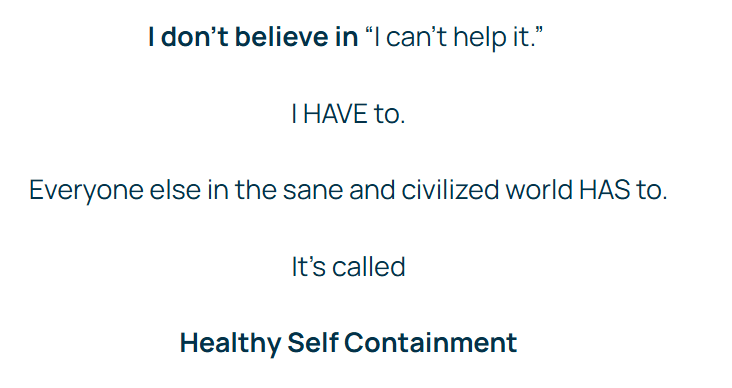
Who wrote it? Me (other people in the world who embodied and displayed dignity, integrity and decency who I choose as guides, senpais, and role models to emulate.
When was it passed? Every challenge I don’t sell myself short.
Every challenge I don’t bark when my chain is yanked.
Every challenge I remind myself and the dog trainers >>> Cats don’t bark.
What was it protecting against? The LACK of dignity, integrity and decency of Self.
Dependency, co-dependency, being taken advantage of, being rolled, used, treated like carpet, scapegoat or beating boy. Being used as a toy. Being used as a wallet.
What’s the penalty clause? Deal with the guilt of selling myself short, and rebuilding and reestablishing healthy boundaries.
Who enforces it now? Me (and the people whose admiration I intend to keep >>> All 2 of my adult children.)


Leave a comment