Impressive how quickly the tools are advancing. The strange part for me is being able to (somewhat) keep up. Still flinching every time Microsoft updates, bracing for the outmode that makes my tech, thus me (my skills, digital ambitions) obsolete again.
It’s the again that stings.
My genX siblings, near graduation in the mid-80s when computers were being installed in schools; sametime and 6 years younger, I was learning on computers since 6th grade. MS paint in Art Class in high school.
This is a strange divide, because most genX were not the science nerds or math geeks that got more computer time, and folks mostly used it for typing or book keeping. Misunderstood appliance or tech tool, like microscopes, left behind in required class, and rarely used or thought of again by most of the high school population.
Then there’s the nerds, who saw and understood how essential this tool would be in the future, not just science, or secretarial work, Every industry, Every home until life is automated and in the care of the Machines.
To some folks automation is heaven… to other some folks it’s a dystopic nightmare.
>>Have and Have Not kind of argument >>most who have don’t think about it until they lose their phone and realize how locked out of everything happens Instantly.
Gotta story for that… about a NASA Engineer I met in the soup line.
Didn’t see “career” ending.
Didn’t have much “family” to fall back on left living after decades in the “career” thus cousin he hardly knew agreeing to couch for a “get back on your feet” few weeks stay >> cut short – due to cousin arrest, thus locked-out, and hungry and has Zero Understanding of his cousin’s town’s outreach systems. >> Fell In the Crack <<
Good thing he met this cat, pulling maps outta my pouch and spending a lunch giving him the walkthrough. I spent six years deep in outreach and being trained through city programs in advocacy and grassroots/community organizing. >IN IT.<
Couldn’t be more in it short of starting my own outreach, on the cusp and irrationally terrified, “What will my family (toxic family) do if they find out… What would my sisters (toxic sisters) do? How would they come after me?
And at this point the collateral damage… nearly 50 households. Families.
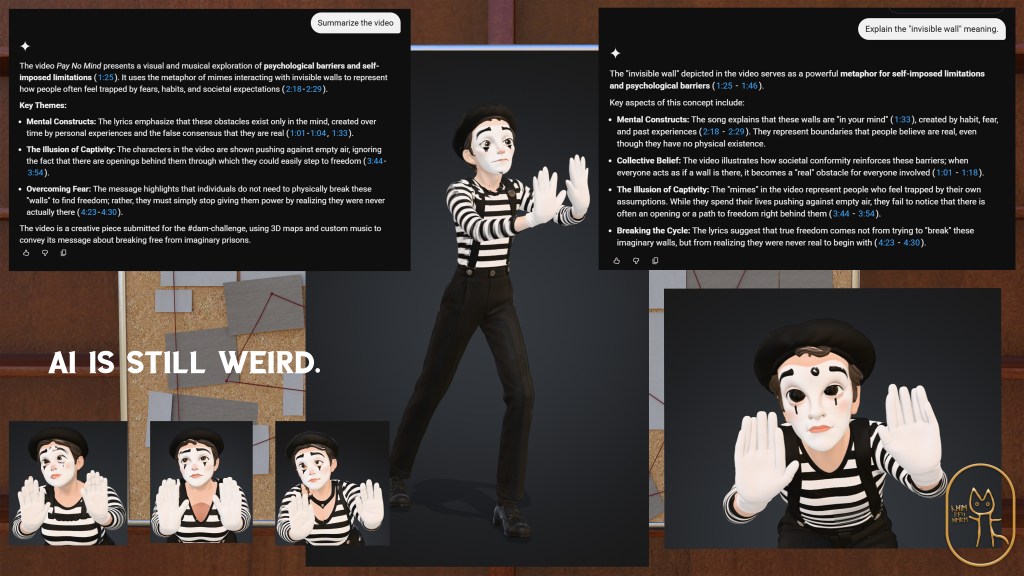
2018. I met my WALL. My invisible wall.
The crux of my self limitations.
Back then 2014, I had been tolerating limited contact (summer visits and holiday calls) with my Eldest tox sister. Staggering (psychologically/emotionally compromised) for months after her visits. It’s hard to describe the kind of dismantling of everything my family and I care about, value, prioritize, spend our time doing, etc etc that she would be opinionated about with a feigned “innocent” “just asking.” Making clear how odd, weird, freaky, unusual, what a waste of time, before her flaunting and flexing about her life.
Tolerable in small doses, with much recovery space.
I got diagnosed with cancer that fall, surgery late spring 2015 and declined the summer visit.
She SEEMED to agree that I was allowed to decline at the time.
In late 2016 she was trying to reconnect, after not talking (punishing me) and pretending to be confused in e-mails and phone calls. She doesn’t understand why I don’t share with her about my life. The way I keep “arguing,” (standing up for myself or calling out her overreach) she “doesn’t know if she likes me as a person.”
That sounds End of Relationship to Me.
So two years later, 2018 flight/fight/freeze… freezing staring at the paperwork to launch my nonprofit and the grant application. It’s too big.
On some level I knew, if they find out I’ve done something big they would come after me to take me down. Cut me down to size. Put me back in my place. I am not allowed to be bigger than them, I am not allowed to do something bigger than them. I’m not important. I’m not allowed to do anything important.
I froze and missed deadlines.
Not too big for me, matched my skills and work.
Too big for them, my toxic family.
An invisible wall made out of their millions of attempts to lessen me, weaken me, tear me down, diminish, distort, and destroy me.
The sister wound that never healed.
The door kept open hoping to heal.
Waiting for the Real sister and all that Real sisterly love to show up.
It never did.
In the summer that same year falling through the floor my (ex)husband promised he “was gonna” fix for years.
Gravity test that popped my splintered ass out of Denial.
I have no time for people like this anymore, and it is self-sabotage learning to tolerate the mishandling at a minimum/ mistreatment at mid/ and abuse when “They Can’t Help Themselves”.
Pretty convinced at this junction it escalates no matter What my role.
Their end goal IS their end goal.
My end goal is something completely different (a little more custom built for me and a hell lot less of what other people Imagine I Have To Be For Them) and I am continuing to move toward that.
Now we get to talk about efficacy!
[O_O] What self-efficacy actually is
Albert Bandura (1925–2021) was a Stanford psychologist, and “self-efficacy” is his term for a person’s belief in their capability to organize and carry out the actions needed to achieve something. That’s close to his own definition in his 1997 book Self-Efficacy: The Exercise of Control.
Three things readers often mix up:
It’s about belief, not skill. Two people with identical ability can have very different self-efficacy, and they’ll behave differently because of it. This is why it can be shaped, damaged, or walled in from outside.
It’s not self-esteem. Self-esteem is about worth (“am I a good person?”). Self-efficacy is about capability (“can I do this?”). You can feel fine about yourself and still believe you’re hopeless at public speaking, or the reverse.
It’s task-specific. Someone can have high efficacy for drawing and low efficacy for taxes. It isn’t one global number stamped on a person.
In his foundational 1977 paper, Bandura also drew a distinction that’s useful for everything we’ve discussed. (last article) An efficacy expectation is “can I do this?” An outcome expectation is “if I do it, will it get me the result?” A person might believe that studying leads to good grades (outcome) and still believe they can’t make themselves study (efficacy). Both can be trapped separately: “you can’t do it” attacks efficacy, “it won’t matter anyway” attacks outcome.
Why it matters so much
In a 1994 encyclopedia chapter, Bandura summarized what efficacy beliefs affect. They influence which challenges people choose (people avoid tasks they believe exceed their ability), how much effort they put in, how long they persist when things get hard, how quickly they recover from setbacks, and how they think and feel along the way, including whether difficulty registers as a challenge to master or a threat to avoid.
That first effect is where the trap closes. If you believe you can’t, you avoid. If you avoid, you never gather the evidence that would prove you could. The belief protects itself by preventing its own test. It’s the Kafka structure running on autopilot.
The four sources, one at a time
Bandura laid out four sources in 1977 and kept refining them through 1997.
1. Mastery experience (the strongest). In 1977 he called this “performance accomplishments.” It’s firsthand evidence of having done the thing. Bandura argued it’s the most powerful source because it’s authentic: it doesn’t depend on anyone’s say-so.
The best-known demonstration came from his work with people who had severe snake phobias (Bandura, Adams & Beyer, 1977). Instead of only talking about the fear or only watching someone else handle a snake, participants went through guided mastery: a therapist demonstrated, then the person took small steps themselves, starting with things like looking at the snake through glass, touching it with gloves, and so on, with supports gradually removed. People who did the guided steps themselves developed stronger efficacy beliefs and bigger behavior changes than people who only watched. And their efficacy beliefs predicted what they’d be able to do next, sometimes better than their past behavior did.
The important refinement: Bandura noted that efficacy built only on easy successes is fragile. If everything comes quickly, people learn to expect quick results and get knocked over by the first real failure. Resilient efficacy comes from overcoming obstacles through persistent effort. Struggle isn’t evidence against you; it’s part of how durable belief gets built.
2. Vicarious experience (watching others). This grows out of Bandura’s earlier research on observational learning, including the famous Bobo doll experiments of the early 1960s, which showed children imitating behavior they’d watched adults perform. For self-efficacy, the key factor is similarity: watching someone like you succeed raises your sense that you could too. Watching someone very unlike you succeed does much less.
Dale Schunk, who worked with Bandura, found something especially useful here. For people with low efficacy, a coping model (someone who visibly struggles, makes mistakes, and works through them) tends to help more than a mastery model who performs flawlessly from the start (Schunk, Hanson & Cox, 1987). The flawless performer can accidentally confirm “people who can do this are a different kind of person.”
3. Verbal persuasion (being told). Encouragement, feedback, and messages about capability. Bandura considered this the weakest of the four for building efficacy, because words aren’t grounded in your own experience and are easily contradicted by it.
But here’s the part that matters for our thread. Bandura pointed out an asymmetry in his 1994 chapter: it’s harder to raise efficacy through persuasion than to lower it. Telling someone they can do something has limited power. Telling someone they can’t, especially an authority figure doing it repeatedly, leads them to avoid challenges, which means they never collect the evidence to disprove the message. Discouraging words are self-protecting in a way encouraging ones aren’t. That’s the diminishing-parent mechanism in Bandura’s own terms.
He also noted that good persuaders don’t just give pep talks. They structure situations so the person is likely to succeed, and they measure success by self-improvement rather than by comparison to others.
4. Physiological and emotional states (reading your body). People partly judge their capability by their own signals: racing heart, sweaty hands, fatigue, mood. Bandura emphasized that it isn’t the intensity of the signal that matters most but how it’s interpreted. The same pounding heart can be read as “I’m going to fail” or “I’m keyed up for something important.” Reducing stress helps, but so does changing the caption on the sensation.
How efficacy is measured
In 1977, Bandura described three dimensions. Level (or magnitude) is how difficult a task you believe you can handle. Strength is how firmly you hold the belief, meaning whether one failure topples it. Generality is how far it extends to related tasks. A person might have strong efficacy for easy tasks only, or weak efficacy across a wide range.
Putting it into practice: small steps
A classic study by Bandura and Schunk (1981) gave children who struggled with arithmetic a set of self-directed lessons. Some set proximal goals (a small number of pages per session), some set a single distant goal (finish all of it), and some set no goals. The proximal-goal group made the most progress, developed the strongest self-efficacy, and showed the most intrinsic interest in math afterward.
The reason connects directly to mastery experience: small, near goals produce frequent, undeniable evidence of progress. A distant goal leaves you in a long stretch with no proof you’re getting anywhere, which is exactly the gap an old discouraging voice can fill.
Tying it back
Everything we talked about before (gossip, hearsay, the diminishing parent, narrative hijacking) works mostly through Bandura’s third channel, verbal persuasion, and it exploits the asymmetry he identified: discouragement is easier to install than encouragement, and it protects itself by producing avoidance. Guided mastery is the counter-structure. It breaks the task into steps small enough that the person can’t avoid succeeding, removes the supports gradually, and lets the evidence accumulate firsthand where no one else gets to narrate it.
References
Bandura, A. (1977). Self-efficacy: Toward a unifying theory of behavioral change. Psychological Review, 84(2), 191–215.
Bandura, A., Adams, N. E., & Beyer, J. (1977). Cognitive processes mediating behavioral change. Journal of Personality and Social Psychology, 35(3), 125–139.
Bandura, A., & Schunk, D. H. (1981). Cultivating competence, self-efficacy, and intrinsic interest through proximal self-motivation. Journal of Personality and Social Psychology, 41(3), 586–598.
Bandura, A. (1986). Social Foundations of Thought and Action: A Social Cognitive Theory. Prentice-Hall.
Bandura, A. (1994). Self-efficacy. In V. S. Ramachandran (Ed.), Encyclopedia of Human Behavior (Vol. 4, pp. 71–81). Academic Press.
Bandura, A. (1997). Self-Efficacy: The Exercise of Control. W. H. Freeman.
Schunk, D. H., Hanson, A. R., & Cox, P. D. (1987). Peer-model attributes and children’s achievement behaviors. Journal of Educational Psychology, 79(1), 54–61.
^-.-^ References!! Look at you go!
Question: is self efficacy something I would have been introduced to in therapy, or in education <<< runs similar to Montessori.
[O_O] Exploring where self-efficacy applies across therapeutic practices.
Both, and often without the name attached. That’s partly why it can feel familiar without being placeable.
In therapy it shows up most in cognitive behavioral therapy and its relatives. Graded exposure (facing a fear in small steps), behavioral experiments (testing a belief by actually trying something and seeing what happens), and behavioral activation (rebuilding a routine through small doable actions) are all mastery experience in practice, descended in part from Bandura’s guided-mastery phobia work. It’s also central in health psychology, addiction and relapse-prevention work, and motivational interviewing, where “supporting self-efficacy” was one of the original core principles. A therapist might say “let’s build your confidence with this” or “let’s test that prediction” without ever saying “Bandura.”
In education it’s standard in teacher training and educational psychology. Dale Schunk and Barry Zimmerman built a whole body of research connecting it to self-regulated learning. You may have met its neighbors instead: scaffolding (support given and then gradually removed, which is basically guided mastery), Vygotsky’s zone of proximal development (the sweet spot just past what you can do alone), and Carol Dweck’s growth mindset, which is related but distinct. Mindset is about whether ability can grow at all; efficacy is about whether you can do this.
And yes, Montessori runs remarkably parallel, even though Maria Montessori was working in the early 1900s, decades before Bandura named anything. She got there by observation rather than experiment, but the overlaps are striking.
Her control of error is probably the closest match. Montessori materials are designed to be self-correcting: if the cylinders don’t fit the holes, the child sees it directly. The feedback comes from the material, not from an adult’s verdict. That’s mastery experience with the verbal-persuasion channel deliberately removed, so no one else gets to caption the result.
Isolation of difficulty, teaching one new element at a time, lines up with Bandura and Schunk’s proximal goals: steps small enough that success is undeniable.
The prepared environment matches Bandura’s point that good encouragers don’t just give pep talks; they structure the situation so success is likely.
Mixed-age classrooms supply vicarious experience, and specifically coping models: a slightly older child who visibly struggled with the same work last year is more convincing than a flawless adult.
And Montessori’s wariness of praise and external rewards, with the adult as guide rather than judge, fits the idea that efficacy built on someone else’s approval is fragile, while efficacy built on your own evidence holds.
The main difference is scope. Montessori is a whole educational philosophy for children, covering concentration, independence, and development. Bandura’s theory is narrower in focus (how capability beliefs form) but broader in reach, tested in phobia clinics, classrooms, workplaces, and health settings across the lifespan. You could fairly say Montessori built the house and Bandura later wrote up why the beams hold.
^-.-^ hmmm…House metaphor, we really deviated from Making Faces (the Title)
I do like how the methods build on each other and interact in reinforcing ways.
Which was going to be a little blooper and behind the scenes. Not quite as serious.
The vision of end goal vs outcome and utility. These Ai are not “perfect.” In case you didn’t notice. Neither are humans.
It takes time for the improvement to happen to SEE the improvements happen.
Not realistic to expect perfection, especially from beginners, newbies, and even new tech tools.
The best metaphor is in photography you have to take 10 pictures to get that one amazing shot. Render many shots making adjustments in between. All don’t come “perfect” >>> the finger issue count in Mesh >>is mostly solved in Leonardo.
Small increments and patience.
Gotta Face it…
Melted Mime is not a good look.
Save face…. public face ..
Impression management…
[O_O] Yes — those ideas cluster around face management, impression management, and narrative control.
- Save face — protect one’s social standing, dignity, or perceived competence after a mistake, conflict, or loss.
- Public face — the version of oneself presented to an audience; it may differ substantially from private thoughts or behavior.
- Impression management — deliberately shaping how other people perceive you.
- Narrative control — influencing which interpretation of events becomes the accepted or dominant one.
- Maintain the upper hand — keeping control of the framing so that the other person is reacting to your version of events rather than establishing their own.
- Face-saving through narrative — when preserving reputation depends on controlling the story about what happened.
A useful distinction is that impression management is about the image, while narrative control is about the story that explains the image.
^-,-^ So lose face?
[O_O] To “lose face”, yes — that’s essentially the opposite of save face.
To lose face means to suffer a loss of social standing, credibility, dignity, or perceived competence in front of others.
And in the framework you’re describing:
Lose face → threat to the public image → impression management → attempt to regain control of the narrative → save face.
For example, someone makes an obvious mistake. If they simply admit it, they may experience a loss of face. If they instead reframe what happened, redirect blame, minimize the mistake, or emphasize circumstances, they’re engaging in face-saving and narrative management.
There’s also an interesting distinction between actually losing status and being perceived as having lost status. The second is where impression management becomes especially important.
^-.-^ 2 face?
[O_O] Ah — “two-face” is a different but related idea.
Two-faced means presenting different faces to different people, usually implying insincerity or hypocrisy.
So you could almost map the concepts like this:
- Save face → protect your public image.
- Lose face → suffer damage to that public image.
- Two-faced → maintain different public faces depending on the audience.
- Impression management → the broader process of shaping how others perceive you.
- Narrative control → shaping the story people use to interpret you and your actions.
And there’s a neat conceptual progression:
Face → two faces → losing face → saving face → controlling the narrative.
If you’re building toward a particular idea or phrase with “2 face,” I think there may be another layer you’re getting at.
^-.-^ False front facade… false face?
[O_O] Yes. “False face” fits the cluster, but it has a slightly different emphasis.
Think of the terms as layers:
- Face — the socially presented self.
- False face — a deliberately presented persona that doesn’t match the underlying reality.
- Facade — the outward appearance maintained to conceal what is behind it.
- False front — an outward presentation designed to make something appear different from what it really is.
- Two-faced — presenting different versions of oneself to different people, often with an implication of deception.
- Impression management — the process of constructing and maintaining those appearances.
- Narrative control — controlling the explanation that makes the appearance seem credible.
- Save face — protecting that constructed social standing when it is threatened.
There’s an especially interesting distinction:
A facade hides the reality. A false face replaces the reality. A narrative explains the false face.
And “false front” has a particularly strong metaphorical connection: a building can have an attractive front that suggests something much grander behind it. The front is essentially the public-facing story.
So if you’re exploring this as a conceptual vocabulary, “false face / false front / facade / saving face / losing face / two-faced / narrative control” all sit in the same neighborhood, but they describe different mechanisms.
Oh, “cut off your nose to spite your face” is perfect for this theme because it takes the metaphor to an absurdly literal place.
It means hurting yourself in an attempt to hurt someone else or prove a point—essentially, the retaliation damages you more than the target.
And look at what happens when you pull it apart:
- Face = the public self / social identity.
- Nose = a prominent, visible part of that face.
- Cut off = deliberately damage or sacrifice part of yourself.
- Spite = the motive is retaliation.
- Face = ultimately, you bear the damage.
So alongside deface, you’ve got:
Save face — protect the image.
Lose face — damage the image.
Deface — damage the visible identity.
False face — construct an identity.
Two-faced — maintain conflicting identities.
Confront — turn and face something.
Face the truth — stop hiding behind the presentation.
Cut off your nose to spite your face — destroy part of yourself just to make a point.
And there’s a wonderfully nasty conceptual connection:
Sometimes protecting the face becomes more important than protecting the person underneath it.
That’s exactly where saving face can become self-defeating—you preserve the facade at the expense of reality.
^-.-^ Before we do a round of hands, let me get this posted.


Leave a comment