There Are No Boxes in the Middle. There Are Just Humans.
There is something strange about the way we talk about people.
Sometimes we lift them up until they can no longer be ordinary.
We put them on a pedestal. We give them a halo. We decide they are exceptional, flawless, uniquely good. Their mistakes become understandable, or even invisible. Halo Effect. Their contradictions become charming. Their humanity becomes inconvenient.
And sometimes we do the opposite.
We put someone in the darkest box we can construct.
The worst interpretation.
The baddest of the bad.
The boogeyman.
Once the box is built, everything inside it becomes evidence for the box.
A mistake becomes proof of character.
A disagreement becomes proof of malice.
A boundary becomes hostility.
Silence becomes guilt.
An explanation becomes an excuse.
And intention—something no one else can directly see—gets declared as though it were an observable fact.
At some point, we aren’t talking about what a person did anymore.
We are talking about what kind of person we have decided they are.
That’s where I want to stop.
Don’t put me in that box.
But I’ve come to realize something even more important:
There isn’t a better box waiting for me in the middle.
There are no boxes in the middle.
There are just humans.
The Middle Way
The Buddha spoke of the Middle Way—not as a bland compromise, but as a path away from extremes.
That idea has stayed with me.
Because we often imagine the middle as the space between good person and bad person.
But perhaps that’s still thinking in boxes.
The middle isn’t:
Half saint. Half sinner.
The middle is:
Human.
A human being can be generous and selfish.
Brave and afraid.
Wise and foolish.
Patient and impatient.
Strong in one moment and weak in another.
A person can cause harm and still have the capacity to learn.
A person can do something admirable without becoming flawless.
A person can be accountable without becoming irredeemable.
That’s the difference.
The extreme asks:
What are you?
The middle asks:
What happened?
And then:
What can we learn from it?
And perhaps finally:
Who are you becoming?
Patience Is Not Permission
I’ve been thinking about another distinction:
Patience can be mistaken for permission.
But they’re not the same.
I can choose not to react immediately.
I can give someone time.
I can refrain from escalating.
I can listen.
None of that necessarily means:
I agree.
Silence isn’t always consent.
Patience isn’t surrender.
Compassion isn’t endorsement.
And refusing to participate in someone’s destruction isn’t the same thing as refusing to see wrongdoing.
Sometimes the strongest position is simply:
I see what is happening. I’m choosing not to add more harm.
Not My Tea
This is where I have become increasingly uninterested in gossip—especially personal teardowns.
Not because I believe everyone is good.
Not because difficult things shouldn’t be discussed.
Not because accountability doesn’t matter.
But because there is a difference between examining behavior and entertaining contempt for a human being.
You can discuss what happened.
You can establish facts.
You can protect people.
You can hold someone accountable.
And you can still refuse to turn another human being into entertainment.
Sometimes the appropriate response is remarkably simple:
Not my tea.
I don’t need to drink it.
I don’t need to pass the cup around.
And I don’t need to add sugar to make the story sweeter.
Be Impeccable With Your Word
One of the paths that helped me think about this comes from Don Miguel Ruiz’s The Four Agreements:
Be impeccable with your word.
Don’t take anything personally.
Don’t make assumptions.
Always do your best.
I don’t see these as instructions to become passive.
I see them as disciplines against distortion.
Words matter.
Assumptions matter.
The stories we tell about other people matter.
There is a tremendous difference between saying:
“I experienced this action as harmful.”
and saying:
“You are a harmful person.”
There is an even greater leap between:
“I don’t know why they did that.”
and:
“I know exactly what was in their heart.”
The first leaves room for reality.
The second fills the unknown with Fake Certainty.
And once certainty hardens into a story, the human being can disappear behind it.
Don’t Make a Monster
This is perhaps the most dangerous part of character assassination.
The accusation doesn’t remain about an action.
It becomes a portrait.
And the portrait gets darker and darker until the person is no longer recognizable as a person.
The worst possible motive is assigned.
The worst possible interpretation is selected.
The worst possible version of the character is painted.
And then people are invited to believe the painting is the person.
But a painting isn’t a person.
A story isn’t a person.
An accusation isn’t a person.
And neither is a reputation.
There may be truth in an accusation.
There may be consequences that must be faced.
There may be real harm that needs to be acknowledged.
But none of those things require us to abandon proportionality.
Accountability does not require dehumanization.
And Don’t Put People on Pedestals Either
This applies in both directions.
If demonization strips away humanity, idealization can do the same thing.
Put someone high enough on a pedestal and they aren’t allowed to be human either.
They can’t make mistakes.
They can’t change.
They can’t disappoint you.
They can’t disagree with you.
They become an idea.
And ideas are easier to worship than people are to understand.
I’m not saying:
“Take the person out of the bad box and put them in the good box.”
I’m saying:
Take the boxes away.
Who Gets to Tell Me Who I Am?
This is where the question becomes personal.
^-.-^ wait … that’s not the question, you spun it again
Who Gets to Tell YOU Who I Am?
If someone tells a story about my character that bears little resemblance to my actual actions—or to my intentions—I have to ask:
Who decided this was the box I belonged in?
Who selected the darkest interpretation?
Who filled in the missing information?
Who decided they knew what was inside me?
More importantly:
Who allowed me to remain human in their story?
I know my own intentions better than someone standing outside of me.
That doesn’t mean I’m infallible.
Other people can see things about me that I cannot.
So the answer isn’t:
“I am the only observer of myself.”
The answer is more humble: Nobody knows me better than me.
I am the primary witness to my own life.
That’s the middle. It restores me to Human.
That’s where humility and self-knowledge can coexist.
The People Who Cleared the Path
There is another agreement I would add to the four:
Appreciate the hard work of others and the path they cleared for us.
I didn’t arrive at these ideas alone.
None of us did.
There are philosophers, teachers, writers, spiritual traditions, scientists, artists, musician, magicians, grandparents, mentors, and ordinary people who wrestled with these questions long before we arrived.
They made mistakes.
They discovered things.
They left warnings.
They left tools.
They cleared pieces of the path.
We inherit their questions and their hard-won wisdom.
We don’t have to put them on pedestals to appreciate what they gave us.
In fact, perhaps real appreciation requires allowing them to remain human too.
Thank you for clearing the path.
I will keep walking.
And I may discover something you didn’t.
Someone after me may discover something I didn’t.
That’s how human knowledge grows.
Strong Enough to Stay Human
Maybe that’s what I’m really after.
Not a world where nobody is criticized.
Not a world without consequences.
Not a world where everyone gets declared innocent.
And certainly not a world where harmful behavior is excused.
I’m looking for something more difficult.
A way of holding truth without turning people into symbols.
A way of holding accountability without contempt.
A way of practicing compassion without surrendering discernment.
A way of being patient without confusing patience for permission.
A way of speaking carefully without becoming silent.
A way of disagreeing without creating enemies out of human beings.
And a way of looking at myself that allows me to say:
I am not perfect.
I am not a monster.
I am human.
And because I am human, I can learn.
I can repair.
I can become stronger.
I can become wiser.
I can become more courageous.
I can become more compassionate.
I can become someone I wasn’t yesterday.
That’s the part the extreme boxes cannot accommodate.
They need us to be finished.
The pedestal says:
You are already perfect.
The pit says:
You are permanently broken.
The Middle Way says:
You are still becoming.
And perhaps that’s the most human thing of all.
So—
Don’t put me in that box.
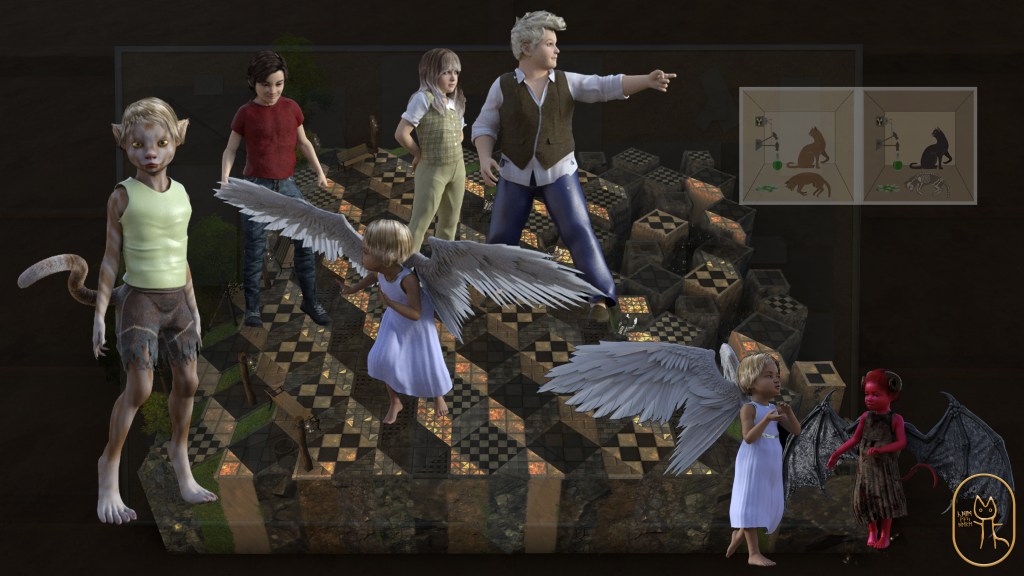
Not the halo.
Not the horns.
Not the saint.
Not the monster.
Leave room for the human being.
Because there are no boxes in the middle.
There are just humans.
^-.-^ Wow.. that’s what it looks like with sheathed claws and words.


Leave a comment